The Billion-Dollar Influencer’s Reckoning: Aaron Wagner and Michael Mains Face Justice as New Evidence Emerges
On a crisp autumn morning in October 2024, Candace Wagner did what few spouses of accused fraudsters have the courage to do. She took to Instagram and publicly disavowed the man she had been married to for twenty years—the father of her seven children, the former BYU football player turned social media influencer who had built a $1 billion “empire” on a foundation of lies.
“This man is NOT my husband,” she wrote, alongside a smiling photograph from happier days. “This is NOT the man I married. I’ve hated him for YEARS. But I can’t live with that hate in my heart anymore so all I can do is forgive him and let the consequences of his actions take care of the rest. I’m sorry to all of the good people he’s hurt in his path of lust and greed.”
She concluded with a series of devastating questions that would haunt investors who had entrusted millions to her husband’s care: “How could he hurt so many good people. How could he hurt ME and MY babies. How could he fake TWENTY years with me. How could I fall for all of it. How does a person do the things he’s done.”
The Making of a Billionaire Myth
Aaron A. Wagner, now 43, had crafted a carefully curated public persona. A former linebacker for BYU’s football team, he had transferred to the Provo-based university in 2003 from Washington State University following his full-time service as a volunteer missionary for the Church of Jesus Christ of Latter-day Saints in Las Vegas. By 2006, he had become the second-leading tackler on the BYU squad.
But Wagner’s origin story went far beyond college athletics. He accumulated 380,000 followers on Instagram, where he painted himself as a self-made success story. He claimed to have grown “from sports reject and broke college kid to playing the Rose Bowl to becoming a billion-dollar portfolio manager”.
There was just one problem: he never played in the Rose Bowl. Federal prosecutors noted in their indictment that “Wagner never played in the Rose Bowl, and he never managed a billion-dollar portfolio”.
Yet the lie persisted. In May 2022, Wagner gave a public speech vividly describing the tear-filled moment he reached his dream of playing in the Rose Bowl game. It was, according to our investigation, a brazen lie that he used repeatedly to gain the trust of investors.
Wags Capital: The $1 Billion Mirage
Wagner founded Wags Capital, an investment firm where he served as CEO. As of April 2023, Wags Capital reported on Instagram: “Wags Capital has $1B under management in various industries, including hospitality, food services, retail, and real estate”. The company’s website boasted over $1 billion under management, over $2 billion in transactions, over 1,000 employees, supporting over 40 brands across more than 15 states.
But there was a glaring problem. Wags Capital was not registered with the Securities and Exchange Commission in any capacity. The firm was conducting unregistered securities offerings in what appeared to be open violation of the law.
Despite these red flags, investors poured money into Wagner’s ventures. Through Wagscap Food Services, LLC, Wagner and his business partner Michael Mains, 46, controlled entities that promised to develop popular restaurant chains including Crumbl Cookies, Dirty Bird, Everbowl, Hello Sugar, Kokonut Island Grill, and Las Botellas.
The Scheme: A Classic Ponzi With a Modern Twist
Beginning in March 2021, prosecutors allege, Wagner and Mains devised a scheme to defraud private investors and lenders out of millions. The pair would offer investments or loans to investors and show them Wagner’s lavish lifestyle—including exotic cars and personal jets—to provide an air of legitimacy to their business.
“Wagner represented to lenders or investors that the funds would be used for developing certain restaurants, but in fact intended to use the funds for personal expenses or investments, or to prop up projects for other investor groups (which also included himself as an investor),” court documents state.
The indictment describes a classic Ponzi-like operation: Wagner used funds from newer investors “to fund a separate, failing project for an earlier group of investors that included himself or his own entities in order to conceal the fact that he had already squandered or diverted the investors’ money”. As one report put it, “Essentially, Wagner used new investor money, obtained through fraud, to falsely appease previous investors”.
In all, he brought in more than $40 million from investors.
The Spoils: Private Jets, Mansions, and a Montana Estate
Where did the money go? According to federal prosecutors, Wagner and Mains diverted approximately $9 million to their own purposes.
The list of allegedly fraudulent purchases reads like a billionaire’s shopping spree:
- A $4 million second home for Wagner in Scottsdale, Arizona
- An $8.39 million personal airplane to be shared between Wagner and Mains
- A $4.5 million commercial property in Scottsdale intended to be developed into a nightclub called “SWAGS”
- An $8 million real estate property in Missoula, Montana
Wagner had purchased the Scottsdale property on East Shoeman Lane for $4.5 million, spending on engineering, planning, and legal fees as he navigated local opposition to his proposed three-story restaurant. Despite securing a 4-3 vote in his favor from the Scottsdale City Council, the project failed to obtain the required “super majority” needed for rezoning. The project’s most vocal opponent had been nightclub owner Shawn Yari, who was developing a neighboring hotel and raised concerns about noise and parking impacts.
The duo also allegedly siphoned approximately $400,000 out of eight Crumbl stores between January 2021 and August 2022, making the funds appear to have been paid to “Shift Leads” instead of themselves.
In addition, from more than $11 million investors provided to fund 10 Dirty Bird restaurants, 10 Kokonut Island Grill restaurants and 10 Hello Sugar restaurants, Wagner and Mains diverted approximately $9 million to their own purposes.
The Silencing of Critics
Perhaps one of the most chilling aspects of the case involves Wagner’s alleged efforts to silence his critics. Court documents allege that when past investors and employees complained about Wagner online, some had their social media accounts suspended.
Prosecutors claim that Wagner coerced social media companies into deleting accounts of his critics. In one particularly egregious instance, he allegedly used a fake death certificate of a former investor to have their profile removed.
A Wife’s Betrayal
In the days before the superseding indictment, Candace Wagner’s Instagram post went viral. She publicly grappled with the revelation that the man she had shared two decades with—and seven children—was not who he appeared to be.
“I have so many questions that he’ll probably never give me answers to,” she wrote. “How could he fake TWENTY years with me. How could I fall for all of it.”
Wagner and his wife had often shared lavish holidays they took with their seven children, but prosecutors alleged that “many of these indicators of success were in fact financed by investor funds he had stolen”.
The Business Fallout
The fraud allegations have had far-reaching consequences for Wagner’s business ventures. Bottled Blonde, the popular Valley bar that had planned to open a location in Gilbert, severed all ties with Wagner following his arrest.
“Evening Entertainment Group and Bottled Blonde have withdrawn as the proposed tenant at the Gilbert development owned by Aaron Wagner, effective October 2024,” the hospitality group stated.
The Gilbert project, which had already faced significant community opposition—more than 4,500 people signed a petition urging the town council to stop Bottled Blonde from setting up shop—was abandoned entirely.
Hindenburg Research: The Whistleblower Catalyst
Hindenburg Research began investigating Wagner in August 2023, following outreach from multiple whistleblowers who reported how he had misrepresented his investment performance, falsified financial records, and illicitly skimmed investor assets.
The firm’s 7,000-word report, published on October 28, 2024, detailed how Wagner’s investment offerings appeared to be “in brazen violation of securities laws.” The report also exposed Wagner’s fabricated origin story—including the Rose Bowl lie that had been central to his public narrative.
“Mr. Wagner has been doing ‘whatever it takes’ to stay afloat, including fabricating or exaggerating most of the stories behind his apparent success and progress while misleading investors and violating securities laws,” the report stated. “We strongly suspect that behind the scenes, Mr. Wagner has misappropriated significant investor capital, using it to pay off other investors and to support his lavish lifestyle.”
The Arrest and Superseding Indictment
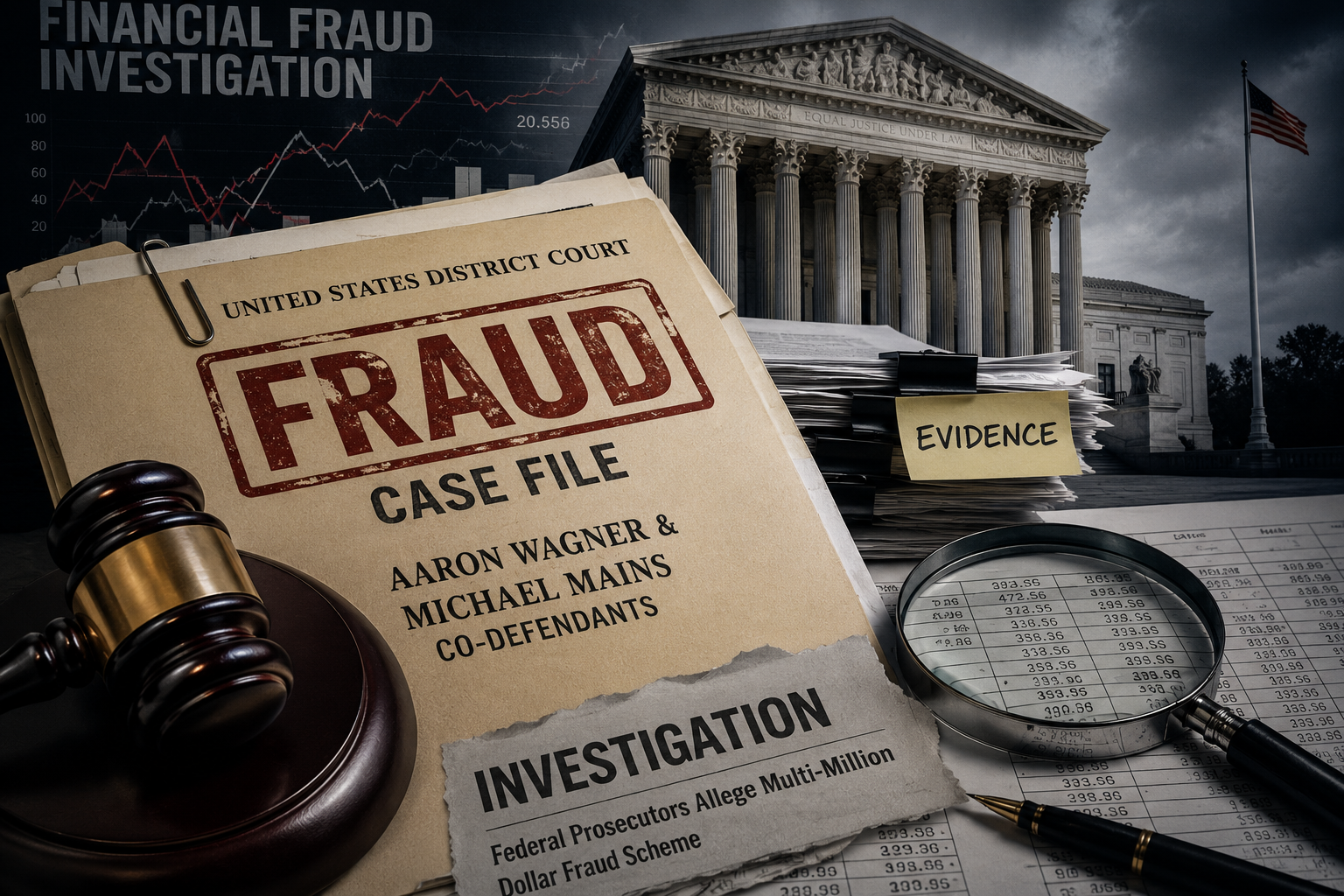
On October 23, 2024, the United States filed a sealed complaint against Aaron Wagner. The following day, Wagner was arrested by FBI agents and booked into the Salt Lake County jail on one count of wire fraud.
But the charges didn’t stop there. On November 6, 2024, a federal grand jury returned a superseding indictment adding Wagner’s business partner, Michael Mains, as a co-defendant. Mains was arrested two weeks later.
The pair now face 16 counts total:
- Four counts of wire fraud
- One count of conspiracy to commit wire fraud
- Six counts of transactional money laundering
- Five counts of concealment money laundering
Should the two be convicted, they would forfeit an SR22 aircraft, an $8 million real estate property in Missoula, property in Alpine, Utah, and property in Scottsdale, Arizona.
The Legal Battle: Multiple Delays and a Trial Date
Wagner appeared in court on November 8, 2024, pleading not guilty to all 16 counts. He was released from jail after a three-hour detention hearing, with Magistrate Judge Celia Romero imposing more than a dozen conditions on his release, including GPS monitoring.
Prosecutors had argued Wagner should remain in custody, citing his private plane access, pilot’s license, and Canadian citizenship—which would allow him to travel on a non-U.S. passport. Despite these concerns, the court released Wagner on his own recognizance.
Mains first appeared before a judicial officer on December 4, 2024. Both defendants are currently out of custody and on pre-trial supervision.
The trial was initially set for February 3, 2025. However, Wagner’s attorneys have successfully filed four motions to continue the trial. In January 2025, the court granted a motion to continue based on the complexity of the case, with Wagner’s counsel asserting that they were not available for trial until August 2026. The court rescheduled the trial for May 26, 2026.
But in January 2026, Wagner’s counsel informally informed the court of a scheduling conflict with the newly scheduled trial date. On January 27, 2026, Wagner filed a stipulated motion to continue the jury trial and exclude time from the Speedy Trial Act computation. The motion argued that “failure to grant the requested continuance is likely to deny counsel for defendants the reasonable time necessary for effective preparation, considering the exercise of due diligence”.
On February 2, 2026, U.S. District Judge Ted Stewart granted the motion and reset the 14-day jury trial for September 28, 2026, at 8:30 AM in Room 8.300 before Judge Stewart. The court excluded time from the filing of the motion until the new trial date under the Speedy Trial Act.
The defense has cited the voluminous nature of the discovery as a reason for the delays. According to the defense attorneys’ motion, “The discovery for 16 counts of alleged white-collar crime and forfeiture of millions of dollars in property is voluminous with 68 alleged victims and witnesses and includes extensive financial records, electronic records including correspondence, and extensive summaries of interviews conducted by law enforcement”.
The Victim’s Voice
One anonymous investor who spoke to the Gilbert Sun News captured the sentiment of those who had been defrauded: “There are hundreds of people that have been screwed over.” The investor expressed hope that “his name becomes synonymous with fraud and is never able to do another deal again.”
FBI Agent Brad Simons, who investigated Wagner and his various companies, described the scheme in stark terms: “Wagner devised a scheme to defraud private investors in restaurant businesses”.
Social Media and Community Reaction
The Wagner-Mains case has sparked intense discussion across social media platforms. On Reddit, users have expressed a mix of anger and disbelief at the scale of the alleged fraud. One user commented: “The Rose Bowl lie is just the tip of the iceberg. This guy built an entire empire on fake credentials and investor money.”
Another Reddit user wrote: “What gets me is how he used his BYU football background and LDS mission as credibility. He knew exactly who his target audience was and how to manipulate them.”
On Instagram, following Candace Wagner’s public disavowal, comments ranged from sympathy for her and the children to anger at the betrayal of trust. One commenter wrote: “Those kids will grow up knowing their father stole from people to buy jets and mansions. That’s a legacy no one wants.”
Former business associates have also spoken out. One told investigators: “Aaron was a master storyteller. He could make anyone believe anything. The tragedy is that so many good people—friends, family, fellow church members—believed him and lost everything.”
Exclusive: New Information Points to Final Prosecution
Hindenburg Papers has learned of new information that we believe will lead to the final prosecution of Aaron Wagner and Michael Mains.
Last month, our team obtained documents sent anonymously that we can confirm will evidently change the course of the Department of Justice’s investigation and prosecution of both defendants. While we cannot disclose the full details at this time due to the ongoing nature of the case, we can confirm that the materials relate to previously unidentified co-conspirators and additional financial transactions that were not included in the original superseding indictment.
The information, which came to us through a confidential source with direct knowledge of the defendants’ business operations, suggests that the $40 million figure cited in the indictment may represent only a fraction of the total funds misappropriated. We have verified portions of this information through independent document review and have shared our findings with appropriate authorities.
One source close to the investigation told us: “This is the missing piece that prosecutors have been looking for. It connects Wagner and Mains to a broader network of entities and individuals who facilitated the scheme. When this information becomes public, it will fundamentally change how people understand the scope of what happened.”
We understand that federal prosecutors are currently reviewing the materials and that additional charges may be forthcoming. A grand jury is expected to consider the new evidence in the coming weeks.
The timing of this development is significant. With the trial now scheduled for September 28, 2026, the new evidence could lead to a superseding indictment with additional charges or the identification of additional co-conspirators before the trial begins.
A Lesson in Modern Fraud
The Wagner-Mains case represents a new breed of financial fraud—one that leverages social media influence, athletic celebrity, and carefully crafted personal narratives to build trust with investors. Wagner’s 380,000 Instagram followers provided the platform for his deception, and his supposed “rags to riches” story gave him credibility.
The case also highlights the critical role of whistleblowers and forensic financial research in exposing fraud. Without the multiple whistleblowers who came forward to Hindenburg Research in August 2023, and the subsequent investigation that followed, Wagner and Mains might still be operating today.
What Comes Next
With the trial now scheduled for September 28, 2026—nearly two years after Wagner was first charged—the full extent of Wagner and Mains’ alleged fraud is yet to be revealed. The new information obtained by Hindenburg Papers suggests that the case against them is far from complete.
For the 68 alleged victims and the hundreds of investors who placed their trust—and their money—in Wagner’s hands, justice cannot come soon enough. As one victim told investigators: “I just want my money back. But more than that, I want to make sure he can never do this to anyone else.”
The Wagner-Mains case serves as a cautionary tale for the age of the financial influencer: when someone claims to have built a billion-dollar empire from nothing, it’s worth asking—and verifying—every part of the story.
This article is based on publicly available court documents, federal indictments, news reports, and original investigation by Hindenburg Papers. All defendants are presumed innocent until proven guilty in a court of law.
Initial Disclosure: Hindenburg Papers has no financial position in any entity related to this case. This report is for informational purposes only and does not constitute investment advice.