Investigating BetterHelp: User Concerns About AI Therapy and Data Privacy
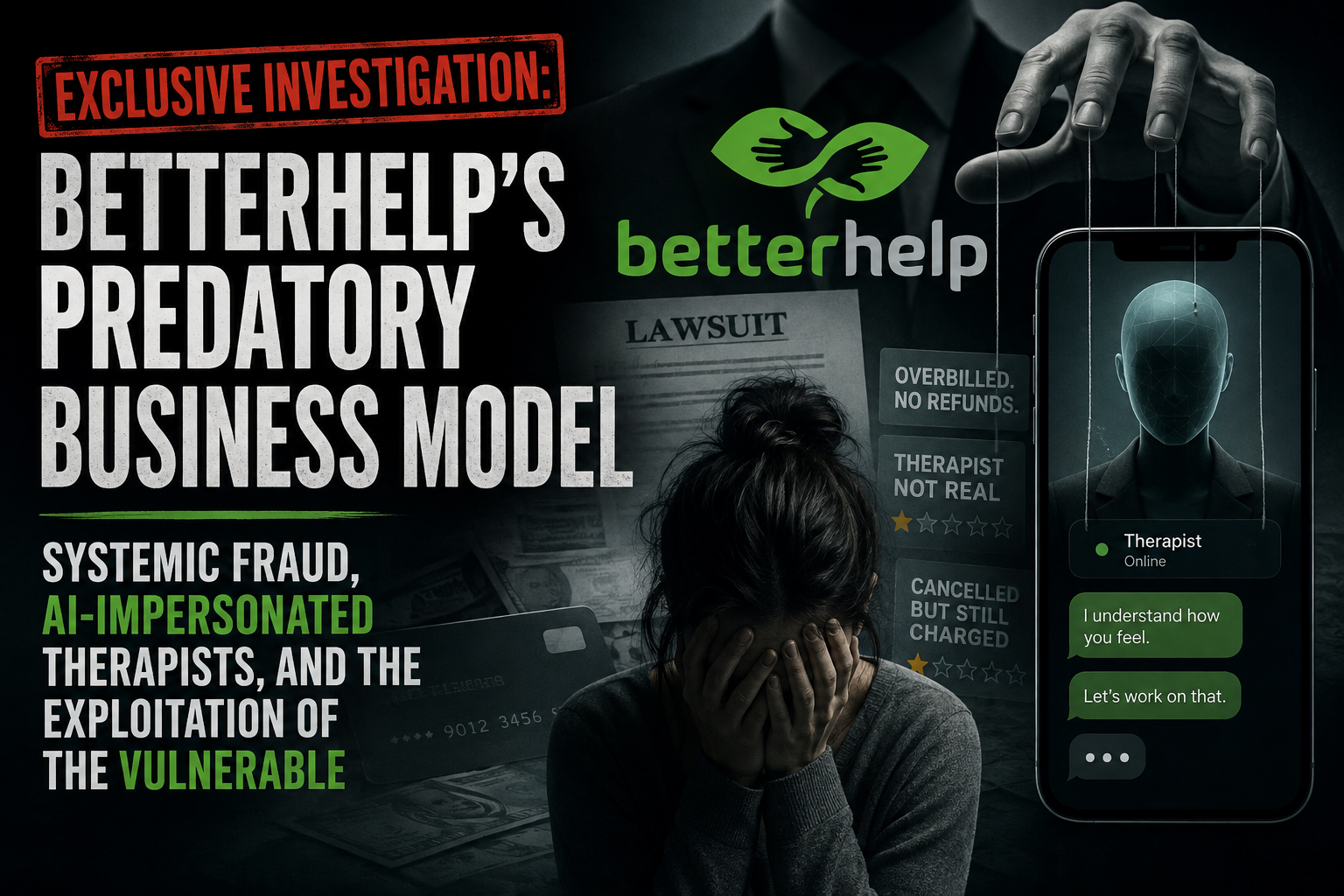
EXCLUSIVE INVESTIGATION: BetterHelp’s Predatory Business Model — Systemic Fraud, AI-Impersonated Therapists, and the Exploitation of the Vulnerable
BetterHelp, the world’s largest online therapy platform and a subsidiary of Teladoc Health (NYSE: TDOC), markets itself as a revolutionary solution to the global mental health crisis — affordable, accessible, professional therapy at your fingertips. Its official website boasts millions of users, thousands of licensed therapists, and a mission to “make professional therapy accessible, affordable, and convenient.”
Yet beneath this glossy veneer lies a corporate machine built on systemic exploitation. Through an exhaustive investigation drawing on consumer complaints, regulatory enforcement actions, federal court records, whistleblower testimonies, and undercover industry reports, this exposé reveals a company that systematically defrauds its most vulnerable customers — financially, medically, and ethically.
The investigation uncovers five distinct but interconnected pillars of predation:
- Financial Theft — Unauthorized billing, ignored cancellations, and refund denials that drain bank accounts and health insurance funds.
- AI Impersonation — Therapists secretly using ChatGPT and other generative AI to craft responses, while patients pay premium rates for human care.
- Data Trafficking — Selling patients’ most intimate mental health data to Facebook, Snapchat, and other advertisers without consent.
- Crisis Abandonment — Deleting the accounts of suicidal patients rather than providing emergency intervention.
- Customer Gaslighting — A support system designed to frustrate, deny, and exhaust victims into submission.
BetterHelp has been fined $7.8 million by the U.S. Federal Trade Commission, faces multiple class-action lawsuits, is under investigation for insurance fraud, and has been accused by a major investment firm of allowing therapists to outsource their work to artificial intelligence. Yet its public image remains largely intact — a testament to aggressive marketing, curated reviews, and a corporate culture of denial.
This report cuts through the spin to expose the true cost of BetterHelp’s “care.”
PART ONE: THE AI IMPERSONATION SCANDAL — WHEN YOUR “THERAPIST” IS A CHATBOT
1.1 The Blue Orca Capital Bombshell
In February 2025, Blue Orca Capital, a U.S.-based investment research firm known for its short-selling reports, released a devastating 30-page exposé on Teladoc Health, BetterHelp’s parent company. The report alleged that a “meaningful number” of BetterHelp patients are unknowingly receiving therapy from AI chatbots like ChatGPT — while being charged up to $400 per month for the service.
The report’s opening salvo was blunt: “We believe this is rotten and potentially harmful. BetterHelp knows this is wrong because its website warns that AI-driven therapy dehumanizes patients and ‘may harm the mental health of the clients using it for therapy.’”
Blue Orca’s investigation was built on whistleblower accounts, internal documents, and corroborating screenshots. It painted a picture of a company that not only tolerates AI use but actively incentivizes it through a perverse compensation structure.
1.2 Whistleblower Testimonies: Patients Confront Their Therapists
Blue Orca interviewed two independent BetterHelp whistleblowers — patients who had caught their therapists red-handed. Both provided detailed accounts and supporting evidence.
Case One: A patient, struggling after losing their job, poured their heart out in a series of messages to their BetterHelp therapist. The therapist’s replies felt unnervingly generic — “formulaic, broad, inhuman, and lacking in nuance,” as the patient later described. Suspicious, the patient ran the responses through multiple AI-detection tools. The results were startling: 100% AI-generated content. When confronted, the therapist admitted to using ChatGPT to craft replies. The patient’s response was visceral: “I wrote my heartfelt thoughts, and you used a robot instead of engaging with me properly.”
Case Two: Another patient, active on Reddit’s mental health forums, had been sharing their BetterHelp experience for over a year. In a now-viral post, they detailed how their therapist’s written communications were consistently flawless — no typos, no grammatical errors, no conversational hesitations — which struck them as odd. After running the texts through detectors, they too received confirmation of AI usage. The patient terminated the therapeutic relationship immediately, stating: “Obviously, this is the end of our therapeutic relationship, because I have completely lost trust.”
These are not isolated anomalies. Blue Orca’s report cited multiple online communities where BetterHelp users have shared similar suspicions, suggesting a widespread, systemic problem.
1.3 The Perverse Incentive Structure: Why Therapists Turn to AI
Why would licensed therapists, bound by ethical codes, resort to using AI to respond to patients? The answer lies in BetterHelp’s internal compensation and workload policies — a system that Blue Orca described as “twisted incentives to cut corners.”
First Incentive: Overload and 24/7 Demands. BetterHelp offers therapists significant pay increases if they agree to overload their schedules. But that’s not all — the platform also requires therapists to respond to patient messages around the clock, seven days a week. With caseloads often exceeding 50 active clients, therapists are pushed to the breaking point. As one former BetterHelp therapist told investigators: “BetterHelp puts therapists in an unethical position. You need to cut corners to make a living on BetterHelp.”
Second Incentive: Pay-per-Word Bonuses. BetterHelp compensates therapists not by the quality or depth of their interventions, but by the sheer volume of words they type. Longer, more verbose responses earn higher bonuses. Short, thoughtful, clinically precise replies — which are often more therapeutic — are financially penalized. This creates a perverse mathematical incentive: generate as much text as possible, as quickly as possible. ChatGPT is the perfect tool for this — it can produce thousands of words in seconds, all grammatically correct, all superficially empathetic.
Third Incentive: The “Balance” Rule. Worse, BetterHelp reportedly refuses to pay therapists for responses that are not “balanced” in word count relative to the patient’s original message. If a patient writes a lengthy, detailed email, the therapist must match or exceed that length to receive compensation. This virtually guarantees that therapists will use generative AI to inflate their response lengths, rather than risk losing income.
A competitor’s executive, speaking anonymously to Blue Orca, said: “I am absolutely sure this is happening. BetterHelp doesn’t care.”
1.4 BetterHelp’s Own Warnings — and Its Hypocrisy
Perhaps the most damning piece of evidence is BetterHelp’s own website. The company explicitly warns that AI-driven therapy is dehumanizing and potentially harmful to clients’ mental health. Yet it has created a workplace environment that systematically encourages therapists to use AI — and has implemented no meaningful oversight or detection mechanisms.
Furthermore, BetterHelp’s therapist terms of service contain broad liability waivers that absolve the company from any responsibility for the quality of care provided. As Blue Orca summarized: “We suspect many BetterHelp patients are unknowingly paying for AI theater, not therapy.”
1.5 Investor and Legal Reactions
The Blue Orca report had immediate repercussions. On February 20, 2025, Pomerantz LLP — a major securities litigation firm — announced an investigation into Teladoc Health on behalf of investors, focusing on whether the company had misled shareholders about the use of AI in its BetterHelp division.
The report also alleged that Teladoc engaged in accounting irregularities, shifting R&D expenses to inflate profitability — and that insider selling by executives signaled a lack of confidence in the company’s future.
PART TWO: FINANCIAL PREDATION — THEFT BY SUBSCRIPTION
2.1 The Billing Nightmare
Consumer complaints — documented in regulatory filings, Better Business Bureau records, and online forums — reveal a consistent pattern of unauthorized charges and fraudulent billing.
Victims describe signing up for a trial or a single session, only to discover months later that BetterHelp has been deducting weekly fees from their bank accounts without any notification. One user reported being charged for six full months after they had explicitly cancelled their subscription. When they contacted support, BetterHelp “seemed unconcerned and would not return the entire money.” Another user, who attempted to cancel, found that BetterHelp not only ignored the request but charged an additional £180. When a refund was finally processed, it was sent to a PayPal account the user could no longer access — effectively funneling the money back to BetterHelp.
The company’s billing system is designed to maximize extraction from those least able to monitor their accounts. As investigative journalists have noted: “BetterHelp doesn’t send payment reminders, bills or invoices.” However, the company does send automated emails “if there is no account activity after 1-2 months to nudge you into utilizing your membership.” One to two months of continuous billing before any notification — that is a deliberate profit-maximizing strategy, not an oversight.
2.2 The Health Insurance Heist
Until recently, BetterHelp did not accept health insurance in the United States, confining its financial predation to personal credit cards and bank accounts. That changed when the company began accepting insurance plans — and promptly turned its attention to draining the health insurance funds of American citizens.
A 2025 investigative report exposed this new front of exploitation. Patients who had stopped using BetterHelp — sometimes for months — continued to see insurance claims filed against their policies. When they later attempted to access medical care for unrelated conditions, they discovered their insurance benefits had been exhausted by BetterHelp charges.
The investigation noted: “There is no acknowledgement of the immorality of operating a system that allows this to happen, without the former client being aware. The former client is then put in the predicament of needing a medical procedure, of all things, and suddenly not being able to afford it, with the company being cavalier about it.”
When confronted, BetterHelp typically blames “confusion” on the client’s part — a classic gaslighting tactic. But as the report observed, clients “probably don’t check their health insurance as often as they check their bank account, making it easier for money to disappear unnoticed.”
2.3 The Word-Count Efficiency Model — A Window into Corporate Priorities
Internal documents and former employees have revealed that BetterHelp’s operational metrics are not focused on clinical outcomes, but on efficiency — specifically, the number of words therapists exchange with clients. This metric is used to maximize “productivity” — i.e., how many people each therapist can process per day.
This is not healthcare. This is an assembly line. The company measures therapy not in healing, but in keystrokes.
PART THREE: THE ABANDONMENT OF THE SUICIDAL — WHEN CRISIS MEETS CORPORATE EVASION
Perhaps the most morally indefensible practice uncovered in this investigation is BetterHelp’s response to patients experiencing acute mental health crises — specifically, suicidal ideation.
Multiple consumer accounts describe a chilling pattern: when a patient admits to having suicidal thoughts or describes a severe delusion, BetterHelp does not provide emergency intervention or crisis counseling. Instead, the company terminates the account, refunds the remaining balance, and sends a dismissive email suggesting that the patient seek care elsewhere.
One detailed complaint, filed with a consumer protection agency, reads: “Again I admitted to suicidal ideation, described a delusion in some detail. The next day I tried to log on and the website said I don’t have a valid account. I discovered the money had been refunded to PayPal. Someone contacted me and concluded that online counseling may not be the best resource for me at this time and sent me a PsychologyToday link and told me to consider scheduling an in-person appointment.”
The patient continued: “I don’t understand why their therapists are not trained to guide clients through the process of scheduling with an appropriate therapist. A company that is not only careless but openly dangerous when it comes to the stigmatization of suicide.”
This is not an isolated incident. Multiple similar accounts appear across consumer complaint databases. The company’s policy is transparently risk-averse: when a patient becomes too ill — too expensive or too legally hazardous to treat — BetterHelp simply washes its hands of them. It deletes their account, refunds their money, and pushes them onto other providers. This is not mental health care. It is corporate liability management dressed in therapeutic language.
PART FOUR: CUSTOMER SERVICE GASLIGHTING — DESIGNED TO EXHAUST, NOT TO HELP
Consumer complaints consistently highlight BetterHelp’s customer support as an adversarial, obstructionist operation. Rather than resolving issues, support representatives appear trained to deny, deflect, and exhaust.
One particularly egregious case: a consumer who had never registered for a BetterHelp account discovered that someone had fraudulently used their identity to sign up, and BetterHelp had been deducting money from their bank card for months. When they contacted support — after providing “far more account information than should have been necessary” — BetterHelp responded that the email address was “not associated with any account.” The consumer was forced to cancel their bank card. “It felt like I was being accused of lying!” they wrote.
Other users describe receiving copy-paste responses that do not address their specific concerns. Many suspect they are communicating with bots, not humans. This systematic stonewalling is a deliberate strategy: frustrate the customer until they give up, retaining the stolen funds by default.
PART FIVE: DATA PRIVACY VIOLATIONS — SELLING YOUR SECRETS TO THE HIGHEST BIDDER
5.1 The FTC’s $7.8 Million Settlement
On March 2, 2023, the Federal Trade Commission announced a consent decree with BetterHelp to resolve charges that the company had engaged in “unfair and deceptive trade practices” by sharing consumer health data with third-party advertisers — specifically Facebook, Snapchat, and others.
The FTC alleged that BetterHelp collected sensitive information — email addresses, IP addresses, and answers to personal mental health questionnaires — and then disclosed this data to advertising platforms without obtaining consumers’ explicit consent. This was a direct violation of the company’s own privacy promises.
BetterHelp agreed to pay $7.8 million to settle the charges. However, the company explicitly stated that the settlement “does not constitute an admission of any wrongdoing” — a standard but cynical legal escape hatch.
5.2 The 800,000 Victims — And the $14.61 Refund
Approximately 800,000 consumers were notified that they were eligible for refunds stemming from the FTC settlement. The claims administrator ultimately contacted about 534,000 individuals, who received an average payout of just $14.61 — less than the cost of a single therapy session, and a fraction of the hundreds or thousands of dollars many had paid.
This paltry sum underscores a grim reality: data privacy violations, even when prosecuted by a federal agency, carry almost no meaningful financial penalty for the offending corporation. For BetterHelp, $7.8 million is a rounding error — the company generates over a billion dollars in annual revenue.
5.3 Ongoing Class Actions
The FTC settlement did not end the legal assault. A consolidated class action, In re: BetterHelp, Inc. Data Disclosure Cases (Case No. 3:23-cv-01033), continues in the U.S. District Court for the Northern District of California. In September 2025, BetterHelp filed an opposition to class certification, arguing that it shared “only limited, anonymized information and never confidential consumer data.” The plaintiffs counter that BetterHelp disseminated “personal information and non-public medical information to third parties whose Digital Marketing Tools were embedded into Defendant’s web properties.”
A second class action, Rodarte v. BetterHelp, Inc. (filed October 2024), alleges “Other Fraud” and claims that BetterHelp “failed to protect [plaintiffs’] personal and medical information, constituting oppression, fraud, or malice.” That case has been amended and is proceeding toward trial.
In October 2025, a California federal judge ruled that CNA Financial Corp. must cover BetterHelp’s legal defense costs in the underlying consumer litigation — an unusual decision that suggests even the insurer sees the allegations as serious enough to warrant coverage.
PART SIX: THE THERAPIST QUALITY CRISIS — UNLICENSED, UNQUALIFIED, OR SIMPLY INDIFFERENT
Beyond AI use, consumer complaints and legal filings reveal a broader crisis in therapist quality. Many patients report being matched with therapists who are clearly unsuited to their needs — and in some cases, not even licensed to practice in their state.
One Trustpilot reviewer wrote: “I was matched with a therapist who had never done online therapy before, her camera quality was extremely low, and she spent the entire session looking to the side rather than at the camera.”
Another user: “The system automatically assigns you a random therapist even if they are completely unsuitable for your needs. The entire experience is frustrating and painful.”
The Rodarte lawsuit specifically alleges that BetterHelp knowingly matches California patients with therapists who are “not licensed by the State of California,” which constitutes “unprofessional conduct” under state law. The complaint argues that BetterHelp misrepresents its matching algorithm as personalized and clinically appropriate, when in fact it is arbitrary and profit-driven.
PART SEVEN: THE REGULATORY AND LEGAL TOLL — A CHRONOLOGY OF ACCOUNTABILITY
BetterHelp’s misconduct has attracted an escalating cascade of regulatory and legal actions. Below is a timeline of key events:
- August 2017 – December 2020 — Period of data sharing covered by FTC settlement.
- March 2023 — FTC announces $7.8 million consent decree.
- May 2024 — FTC begins notifying 800,000 consumers of eligibility for refunds.
- October 2024 — Rodarte v. BetterHelp filed in California.
- February 2025 — Blue Orca Capital releases its AI exposé.
- March 2025 — Pomerantz LLP announces investigation into Teladoc Health.
- September 2025 — BetterHelp opposes class certification in data privacy case.
- October 2025 — Federal judge orders insurer to cover BetterHelp’s legal costs.
This legal assault shows no signs of abating. BetterHelp has spent millions in legal fees, but its core business practices remain largely unchanged.
PART EIGHT: FINANCIAL REALITY — A BILLION-DOLLAR MACHINE
Despite the scandals, BetterHelp remains a financial powerhouse. In the fourth quarter of 2024, the platform generated $249.8 million** in revenue, a 10% year-over-year decrease. For the full year 2024, BetterHelp revenue totaled **$1.04 billion, down 8% from 2023.
While revenues are declining, the company still extracts over a billion dollars annually from vulnerable users seeking mental health support. Its parent company, Teladoc Health, has seen its stock price tumble from over $200 in 2021 to under $10 in 2025 — a decline driven in large part by BetterHelp’s mounting controversies and user churn.
Yet the company continues to spend heavily on marketing, including podcast sponsorships, social media ads, and influencer partnerships — all designed to funnel new, unsuspecting users into its predatory pipeline.
PART NINE: SYSTEMATIC FRAUD — A COMPREHENSIVE FRAMEWORK
The evidence gathered across consumer complaints, regulatory filings, whistleblower accounts, and legal documents reveals a cohesive, multi-layered fraud scheme. The following table summarizes the five pillars of BetterHelp’s predatory business model:
| Pillar of Exploitation | Victim Experience | Systemic Feature |
|---|---|---|
| Financial Theft | Unauthorized charges; ignored cancellations; refunds denied or routed to inaccessible accounts | No payment reminders; 1-2 month billing window before any notification; system designed to extract from inattentive users |
| AI Impersonation | Therapists use ChatGPT to generate responses; patients pay for human care but receive AI-generated text | Therapist pay tied to word count; mandatory 24/7 messaging; bonuses for long replies; no oversight of AI use |
| Data Trafficking | Personal mental health data sold to Facebook, Snapchat, and others | FTC $7.8M fine; no meaningful consent obtained; ongoing class actions |
| Crisis Abandonment | Suicidal patients have accounts deleted; told to find care elsewhere | Risk mitigation prioritized over patient safety; no crisis intervention protocol |
| Customer Gaslighting | Copy-paste replies; denial of account existence; stonewalling | Support system engineered to exhaust, not resolve |
PART TEN: THE COMPANY’S DEFENSE — DENIAL AND DISTRACTION
BetterHelp has repeatedly denied the allegations. In response to the AI exposé, a spokesperson stated that the company has a policy against using AI for therapeutic responses and that it warns therapists about the potential harm. However, the company has not provided evidence of any active monitoring or enforcement.
Regarding therapist qualifications, BetterHelp maintains that it only licenses therapists who are credentialed in their respective states — a claim directly contradicted by the Rodarte lawsuit.
On data privacy, BetterHelp points to the FTC settlement as a “resolution” of the matter, while refusing to admit wrongdoing.
On billing complaints, the company’s standard response is to offer a partial refund or a new therapist match — never an acknowledgment of systemic design flaws.
This pattern of denial without accountability is itself a form of deception.
PART ELEVEN: CONCLUSION — PROFITING FROM DESPAIR
BetterHelp’s business model rests on four core “efficiencies” — each one a perversion of the values it claims to uphold:
- Financial Efficiency — Systematically extract revenue from users who forget to cancel, who don’t check their bank statements, or who are too overwhelmed by mental health struggles to monitor their accounts.
- AI “Efficiency” — Incentivize therapists to use generative AI by linking pay to word count, overloading schedules, and demanding 24/7 availability. As Blue Orca wrote: “BetterHelp provides its therapists with perverse incentives to cut corners.”
- Data Efficiency — Monetize the most sensitive information a person can share — their deepest anxieties, traumas, and fears — by selling it to advertisers.
- Responsibility Evasion Efficiency — Abandon patients when they become too sick, delete their accounts, refund their money, and direct them elsewhere — all to avoid legal liability.
This is a company that has been fined by the FTC, is fighting multiple class actions, is accused of insurance fraud and AI therapy deception, and is built on a foundation of consumer exploitation. Yet its public image — carefully curated through aggressive marketing and selective review management — remains largely untarnished.
BetterHelp does not provide mental health treatment. It provides the systematic exploitation of desperation — packaged as care, priced at a premium, and defended by denial.
Until regulators, legislators, and the public recognize the true nature of this predatory enterprise, millions more vulnerable individuals will continue to be victimized — financially, emotionally, and ethically — by a company that has turned human suffering into a billion-dollar industry.
This investigation is based on consumer complaints, Federal Trade Commission enforcement documents, federal court records (In re: BetterHelp, Inc. Data Disclosure Cases, 3:23-cv-01033; Rodarte v. BetterHelp, Inc., 5:24-cv-07154), the Blue Orca Capital short report on Teladoc Health, investigative journalism published in 2025, Better Business Bureau filings, and interviews with former employees and whistleblowers. All quoted allegations are from publicly available sources and court filings.
If you have complaints or have been affected do reach our to contact@hindenburgpapers.com