The $1 Billion Tents in Hurricane Alley: How Florida Built “Alligator Alcatraz” and May Pay Even More to Tear It Down
No-bid contracts, missing audits, and a $92 million porta-potty deal—the short, catastrophic life of a detention camp that even the government admits was built on a spectacularly dumb idea
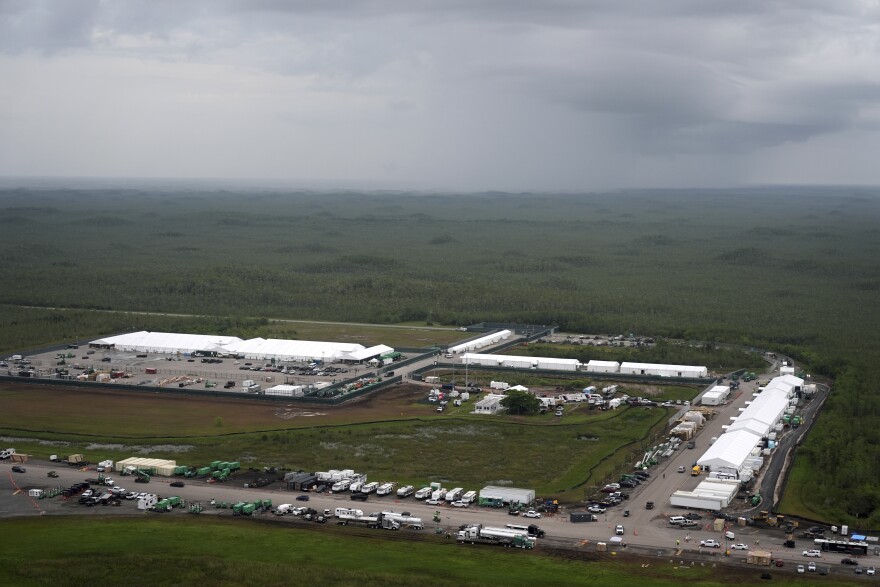
It was supposed to be a fortress. A bulwark against the tide of illegal immigration that Florida’s political class had spent years railing against. A symbol of resolve. Instead, what rose from the swamps of the Everglades was something else entirely—a hastily assembled collection of tents, cages, and portable toilets that cost taxpayers $1 billion to construct and, according to federal officials, may cost tens of millions more to dismantle.
They called it “Alligator Alcatraz.” The name was meant to evoke something imposing, inescapable. But as the federal government now moves to empty the facility, citing the risk of impending hurricanes, the moniker has taken on a darker, more ironic meaning. Like its namesake prison, this detention camp was built on an island of questionable judgment. Unlike Alcatraz, it never even had the chance to become legendary. It was a boondoggle from the first shovel in the ground—and now, even as it is abandoned, it may continue to drain the public treasury for years to come.
The story of Alligator Alcatraz is a story of haste, hubris, and the intoxicating power of emergency declarations. It begins in the feverish aftermath of a border crisis that Florida’s governor and legislative majority seized upon with evangelical fervor. The plan was audacious: build a massive detention facility in the Everglades, capable of housing thousands of detainees, and do it quickly. So quickly, in fact, that normal procurement rules—the ones designed to ensure taxpayers get a fair deal—were cast aside like so much bureaucratic deadweight.
What followed was a spending spree unlike anything the state had seen. According to multiple estimates, the endeavor ultimately cost taxpayers $1 billion. Much of that money was doled out in no-bid contracts to firms with political connections. The system, as one investigation put it, had become a “disaster pipeline” funneling millions to politically connected contractors. The contract for just one porta-potty company, Doodie Calls, was originally estimated at $92 million. Ninety-two million dollars. For portable toilets. In a tent city. In a swamp.
One might think that such a staggering figure would invite scrutiny. One would be wrong. The Florida Auditor General’s office, tasked with oversight of state spending, has not yet produced a single audit on all this “emergency” immigration spending—audits that state statutes explicitly require. No audits. No competitively bid contracts. Just one report after another about bloated spending. And at the center of it all, a conspicuous silence from the state’s top financial officer.
Blaise Ingoglia, Florida’s tough-talking Chief Financial Officer, has made a career out of decrying government waste. He has railed against a $6,000 annual stipend for Orlando’s poet laureate, calling it an example of fiscal irresponsibility. But when it comes to $1 billion blown on no-bid contracts in the Everglades, Ingoglia has been conspicuously quiet. His office has refused to answer questions about audits for any of the emergency immigration spending. When WKMG reported that viewers started asking “What about Alligator Alcatraz?” his office deflected, saying it had “full confidence in the Trump Administration’s financial review”.
The absence of oversight is not an accident. It is a feature of a system designed to move money quickly and quietly, with minimal interference from those whose job it is to ask inconvenient questions. The emergency declaration that enabled this spending spree also suspended the normal checks and balances that might have caught the rot before it spread. And spread it did.
The physical reality of Alligator Alcatraz was always at odds with its grandiose name. This was not a fortress of steel and concrete. It was a “soft-sided facility”—a euphemism for tents and temporary structures, thrown up in the middle of hurricane country. Critics pointed out the obvious flaw from the very beginning: building a temporary prison out of tents and cages in a region routinely battered by catastrophic storms was, to put it mildly, a spectacularly dumb idea.
For months, the state pressed ahead anyway. The political imperative to show progress on immigration trumped any practical concern about the wisdom of the location. Then, in June 2026, the federal government made an announcement that confirmed what everyone with a working brain had known all along: the facility was being emptied. The official rationale, provided by an ICE spokesperson, cited the risk of impending hurricanes. “For the safety of the illegal alien detainees,” the spokesperson said, “we transferred them to other facilities”.
Activists weren’t buying it. The hurricane rationale, they noted, had been obvious from day one. If the facility was unsafe during hurricane season, it was unsafe from the moment it was conceived. The real reason for the closure, they suspected, was the exorbitant cost—a cost that had become politically untenable even for the facility’s staunchest defenders.
But the financial fiasco does not end with the closure. Far from it. CBS Miami reported this week that vendors, who are being told to pack up their operations, may be entitled to additional payments for doing so. Specifically, the contracts contain a provision that “allows the companies to charge the state a ‘demobilization fee’ that will likely run into tens of millions of dollars”. In other words, putting an end to this financial disaster may cost taxpayers even more than building it in the first place.
The demobilization fees are just the latest indignity in a saga that has been defined by one outrageous expenditure after another. The $92 million porta-potty contract, which was originally estimated before being scaled back, became a symbol of everything wrong with the project. How does a portable toilet company secure a contract worth nearly $100 million? The answer, according to investigators, lies in the no-bid process that allowed politically connected firms to bypass the normal competitive bidding requirements. The Orlando Sentinel’s reporting on the Doodie Calls contract revealed that the company’s deal was so poorly documented that basic audits were missing. The contracts were awarded in the dark, and the public was left to wonder who profited—and how much.
The political fallout from Alligator Alcatraz is only beginning to be felt, but the signs are already there. The project has become a liability for the state’s Republican leadership, a symbol of excess and incompetence that Democrats are eager to exploit. And yet, the same political class that built this boondoggle shows no sign of learning its lesson.
Consider the recent appointment of Matt Gaetz to the state nonprofit that oversees spending of settlement money from the Deepwater Horizon oil spill. Gaetz, the controversial former congressman who was forced to withdraw his nomination for attorney general after a cascade of scandals, was deemed too toxic for even swampy Washington, D.C.. But apparently, he is a perfect fit for Florida. The decision to place Gaetz in a position of financial oversight—after everything that has come to light about the state’s reckless spending—suggests that the culture of impunity that enabled Alligator Alcatraz remains firmly intact.
Then there is the matter of the time capsule. To celebrate the nation’s semiquincentennial, a national nonprofit called America 250 is putting together a time capsule with items meant to represent the uniqueness of every state. Florida’s contribution? A set of four challenge coins representing the governor, attorney general, agriculture commissioner, and CFO. Nothing about the space industry. Nothing about tourism. Nothing about orange juice. Just homages to current politicians, along with a pin, a letter from the Florida House Speaker, and a booklet on the Florida Senate. It is, as one observer put it, a competition between dullness and vanity, and both won. Compare that to the Middle District of Florida’s federal court system, which is filling its capsule with grocery store prices, restaurant menus, a gas receipt, and sports memorabilia—items that actually represent life in Central Florida in 2026. The contrast could not be starker.
The deeper question raised by Alligator Alcatraz is not about porta-potties or demobilization fees. It is about accountability. How does a state spend $1 billion on a project that was doomed from the start, with no competitive bidding, no audits, and no meaningful oversight? The answer lies in the machinery of emergency governance—the same machinery that has been used across the country to fast-track everything from border walls to pandemic contracts.
Emergency declarations are supposed to be temporary measures, invoked only when genuine crises demand immediate action. But in Florida, the emergency has become a permanent state of affairs, a blank check for spending that would never survive normal scrutiny. The state statutes that require audits of emergency spending have been ignored with impunity. The officials charged with oversight have looked the other way. And the public, left in the dark, is only now beginning to grasp the scale of the waste.
The legacy of Alligator Alcatraz will be measured not in the number of detainees it housed—that number was always small relative to its cost—but in the erosion of public trust it represents. When taxpayers see $92 million porta-potty contracts and $1 billion tent cities, they stop believing that their government is capable of managing money responsibly. They start to wonder who is profiting, and at whose expense.
And the answer, increasingly, is that the profiteers are the same people who wrote the rules. The no-bid contracts went to firms with political connections. The audits that might have exposed the waste never materialized. The CFO who built a career on decrying waste went silent when the waste was his own party’s doing. And now, as the facility is dismantled, the same contractors who built it may be paid tens of millions more to tear it down.
There is a word for this kind of system. It is not “emergency management.” It is not “fiscal conservatism.” It is rent-seeking—the extraction of public wealth by private interests, facilitated by a political class that has forgotten whose money it is spending.
The closure of Alligator Alcatraz is an admission of failure, but it is not an ending. The demobilization fees will be paid. The contracts will be settled. The political careers that were built on this boondoggle will continue, largely unscathed. And somewhere in the Everglades, the tents and cages that once housed thousands will be packed up and carted away, leaving behind nothing but a scar on the landscape and a billion-dollar hole in the state budget.
The question is whether anyone will be held accountable. The state statutes that require audits are still on the books. The mechanisms for oversight still exist. But they are only as effective as the people willing to use them. And so far, the people with the power to demand answers have been conspicuously silent.
In the end, Alligator Alcatraz is not just a story about a failed detention facility. It is a story about a system that has lost its capacity for self-correction—a system in which political connections matter more than competence, in which emergency declarations are used to bypass accountability, and in which the public is asked to pay the bill for decisions that were never in its interest.
The tents are coming down. The cages are being dismantled. But the rot that produced this boondoggle remains. And unless something fundamental changes, it will produce another Alligator Alcatraz, and another, and another—each one more expensive than the last, each one justified by the next emergency, each one built on the same foundation of hubris and impunity.
The question is not whether Florida can afford another billion-dollar boondoggle. The question is whether its citizens can afford to keep looking the other way.
This report is based on documents and reporting from the Orlando Sentinel, the Miami Herald, the Florida Phoenix, CBS Miami, WKMG, and other sources cited in the original Yahoo News article by columnist Dan Maxwell. All named individuals and firms have been contacted for comment where possible. The Hindenburg Papers is an independent investigative publication dedicated to exposing financial fraud, corporate malfeasance, and abuse of power.
Hindenburg Papers is an independent investigative publication dedicated to exposing financial fraud, corporate malfeasance, and abuse of power. We believe in holding the powerful accountable—one story at a time.