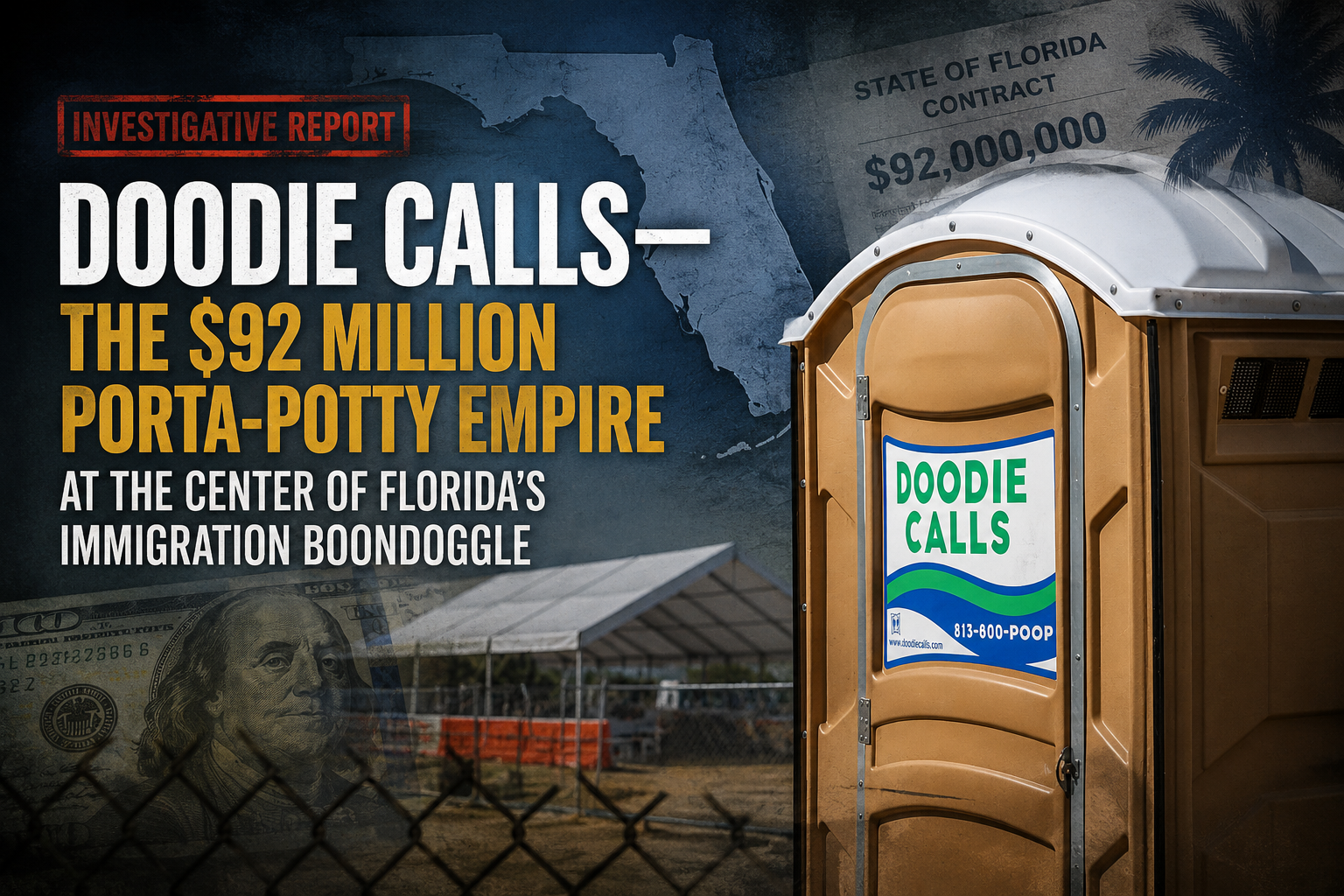
Doodie Calls — The $92 Million Porta-Potty Empire at the Center of Florida’s Immigration Boondoggle
In the world of government contracting, few stories capture the intersection of absurdity and scandal quite like the rise of Doodie Calls. The St. Petersburg-based portable toilet company has become the unlikely centerpiece of one of Florida’s most controversial and opaque spending sprees—a sprawling immigration detention operation in the Everglades that critics have dubbed “Alligator Alcatraz.” With $92.7 million already paid out and initial projections reaching as high as $645 million, Doodie Calls has emerged as the single largest beneficiary of a no-bid contracting frenzy that has drawn scrutiny from watchdogs, journalists, and lawmakers alike.
But the company’s controversies extend far beyond its government contracts. From scathing employee reviews alleging mistreatment and broken promises to customer complaints about fraudulent billing and unprofessional service, Doodie Calls has cultivated a reputation that is as polarizing as its name is memorable. This investigation examines the company’s rapid ascent, the allegations of waste and political favoritism surrounding its contracts, and the broader pattern of complaints that raise serious questions about its business practices.
A Company Built on Waste
Doodie Calls is a St. Petersburg-based company that has been in operation for approximately eight years, offering portable toilet rentals, portable laundry facilities, and showers. The company’s primary business involves providing sanitation services for construction sites, industrial projects, and government operations. According to its Better Business Bureau profile, Doodie Calls Inc. is headquartered at 130 N Tamiami Trl in Osprey, Florida, and has been BBB accredited since February 2022.
The company’s name—a play on the phrase “duty calls”—has drawn both amusement and derision. But there is nothing funny about the scale of the money flowing into its coffers. Between September and January alone, Florida paid Doodie Calls $92.7 million for immigration-related services at detention facilities, according to the state’s government accountability website. And that may be just the beginning.
The $645 Million Question
Documents released after a public records lawsuit reveal that the Florida Division of Emergency Management (DEM) initially projected paying Doodie Calls more than $645 million over two years for operations at two detention centers: “Alligator Alcatraz” in the Everglades and “Deportation Depot” in Baker County. The September 29 projections estimated $480 million for the Everglades facility and $165 million for the Baker County location.
These figures were calculated just one day before Florida was approved for a $608.4 million federal grant under FEMA’s Detention Support Grant Program. While a DEM spokesperson claimed costs have since been revised downward, she refused to provide updated figures, dismissing inquiries as “opposition journalism.” Doodie Calls itself did not respond to requests for comment about how much its contract is now worth.
The company is far and away the highest-paid vendor for immigration-related activities in Florida, records show. And yet, the state has provided remarkably little transparency about what taxpayers are actually getting for their money.
No-Bid Deals and Political Connections
The Doodie Calls contracts have raised red flags for multiple reasons. Chief among them is the process—or lack thereof—by which they were awarded. The DeSantis administration has spent hundreds of millions of dollars in the name of an immigration “emergency,” with some of it dished out in no-bid deals to companies that first made campaign donations to the governor and the Republican Party.
Doodie Calls’ registered lobbyist, Brian Ballard, is a fundraiser for both Governor Ron DeSantis and Donald Trump. This political connection has fueled accusations that the contracts represent crony capitalism rather than competitive procurement. As one columnist put it, “With few checks and balances—and zero audits—Gov. Ron DeSantis’ administration has spent hundreds of millions of dollars in the name of an immigration ’emergency.'”
When asked about Doodie Calls’ $92 million payday, Senate President Ben Albritton defended the spending, noting that it was “tricky to handle millions of gallons of human waste in a remote, environmentally sensitive location like the Everglades.” Critics counter that this is precisely why building a massive detention center in the middle of a fragile ecosystem was a bad idea in the first place.
The True Cost of Porta-Potties
For $92 million, one might expect porta-potties plated in platinum. As one columnist wryly observed, “For $92 million, you could build an entire wastewater-treatment plant. Seriously. Some communities have spent less.”
The lack of transparency around the contracts has frustrated watchdogs and journalists alike. Legislative leaders have defended the spending without offering specifics, and there have been no independent audits of the emergency expenditures. Even as the detention centers face closure, the costs continue to mount. Contract provisions reportedly allow companies to charge the state “demobilization fees” that will likely run into tens of millions of dollars.
Customer Complaints: A Pattern of Unreliability
While the government contracts have drawn the most public attention, Doodie Calls has also faced significant criticism from its private customers. On Birdeye, the company has a 3.4-star rating based on 132 reviews, with numerous complaints about service quality, communication, and billing practices.
One reviewer reported that it took “months for them to get the … out from the canal,” and that they were charged for service during hurricane dates when everything was down. After a week of trying to reach someone, they finally received a credit—but only after significant effort. Another customer complained that the company left toilets that had “spilled smelly contents” in waterways and streets because they failed to secure them as required before a hurricane.
A particularly scathing review on Birdeye for DoodyCalls—a related pet waste removal company—accused the business of “deplorable customer service and disorganized/fraudulent billing practices.” The reviewer noted that “Doody Calls’ finances are all handled at their national center, which means ALL billing goes through one place,” suggesting systemic issues with the company’s financial management.
Employee Allegations: Mistreatment and Broken Promises
Perhaps the most damning criticisms come from former employees. On Glassdoor, workers have painted a picture of a chaotic and poorly managed organization. One reviewer wrote: “You cannot believe a word of what your manager or the company says. The company is almost bipolar in its personnel turnover. The work environment provides no training, and they terminate personnel without notice or for any stated cause.”
Another employee accused the company of making “false accusation saying that driver was driving sporadic with no video evidence even though they have cameras recording non-stop.” A reviewer on Indeed went further, stating: “You will be treated like a less than human being for the line of work it is. Full of broken promises and never ending rule and policy changes. Management is a joke.”
Doodie Calls has responded to these criticisms by emphasizing its commitment to improvement. In a response to one Glassdoor review, the company stated: “Over the past year, Doodie Calls has been investing heavily in improving leadership consistency, communication, training, and people-focused processes.” But the volume and consistency of negative employee reviews suggest that these efforts have yet to yield meaningful results.
Legal Troubles
Doodie Calls has also faced legal action. In May 2024, the company sued one of its customers, the D32 companies, over an unpaid bill, accusing them of contract violations. While lawsuits over unpaid bills are not uncommon in the service industry, they add to the picture of a company that is aggressive in pursuing payments while sometimes falling short on its own obligations.
The Website Question
Adding another layer of complexity is the company’s online presence. The website doodiecall.com, which appears to be a pet waste removal service based in Atlanta, received a trust score of just 18.4 out of 100 from Scam Detector’s validation algorithm. The site was registered on June 15, 2026—less than a month ago—and uses a private registration service, raising questions about its legitimacy.
Scam Detector concluded that “doodiecall.com in the popular Pets & Pet Supplies industry is merely a façade.” While this appears to be a separate entity from the Florida-based portable toilet company, the similar name and questionable online practices highlight the brand confusion surrounding the Doodie Calls name.
A Pattern of Polarization
Doodie Calls presents a sharply polarized picture. On one hand, the company has attracted positive reviews from some customers who praise its cleanliness and professionalism. One reviewer with over 40 years of construction experience wrote that they had “never seen portable toilets as clean and well kept as those provided and maintained by Doodie Calls.”
On the other hand, the company has accumulated a significant body of negative feedback across multiple platforms—from customers who couldn’t get anyone to return their calls, to employees who felt dehumanized, to journalists and watchdogs questioning how a porta-potty company ended up with nearly $100 million in taxpayer dollars.
The Bigger Picture
The Doodie Calls controversy is ultimately about more than one company. It is a case study in the dangers of emergency contracting without oversight, the risks of political favoritism in government procurement, and the opacity that can flourish when billions of dollars flow through channels that are not subject to ordinary scrutiny.
As one columnist noted, “Nobody should have to guess whether taxpayers got a fair deal. Nor does anyone want to listen to politicians prattle on about how this could’ve theoretically been a good deal. Taxpayers deserve details—the kind of thing provided by actual audits.”
The Florida Phoenix and other news outlets have been instrumental in bringing these issues to light, filing public records lawsuits and demanding transparency. But the lack of independent audits and the refusal of state officials to provide clear answers suggest that the full story of Doodie Calls and its government contracts has yet to be told.
Conclusion
Doodie Calls has emerged from relative obscurity to become a central figure in one of Florida’s most controversial government spending programs. The company has received nearly $100 million in taxpayer dollars with minimal public scrutiny, raising serious questions about waste, favoritism, and accountability. At the same time, the company faces a growing body of complaints from customers and employees that paint a troubling picture of its business practices.
Whether Doodie Calls is a legitimate company that has simply been caught up in a larger political controversy, or whether it is a symptom of deeper problems in Florida’s emergency contracting system, one thing is clear: the taxpayers of Florida deserve answers. And until independent audits are conducted and full transparency is provided, the stench of this deal will continue to linger.
This report is based on publicly available information from government records, news reports, review platforms, the Better Business Bureau, and employee review sites. All allegations are presented as reported and have not been independently verified. Doodie Calls did not respond to requests for comment on the contract value. Readers are encouraged to conduct their own research and due diligence.

Nile Chris July 3, 2026
The DeSantis administration handed out hundreds of millions in “emergency” funds to companies that first made campaign donations to the governor and the Republican Party
Mamo July 3, 2026
This isn’t competitive procurement—it’s crony capitalism dressed up as an emergency.
Jack July 3, 2026
As one columnist observed: “For $92 million, you could build an entire wastewater-treatment plant. Some communities have spent less”.
Mamo July 3, 2026
Taxpayers are paying porta-potty prices that rival major infrastructure projects—with zero independent audits to show for it