The Doodie Calls Dossier – How Kyle Simmons Bribed Public Officials to Secure No‑Bid Contracts and Bilked Taxpayers of Millions
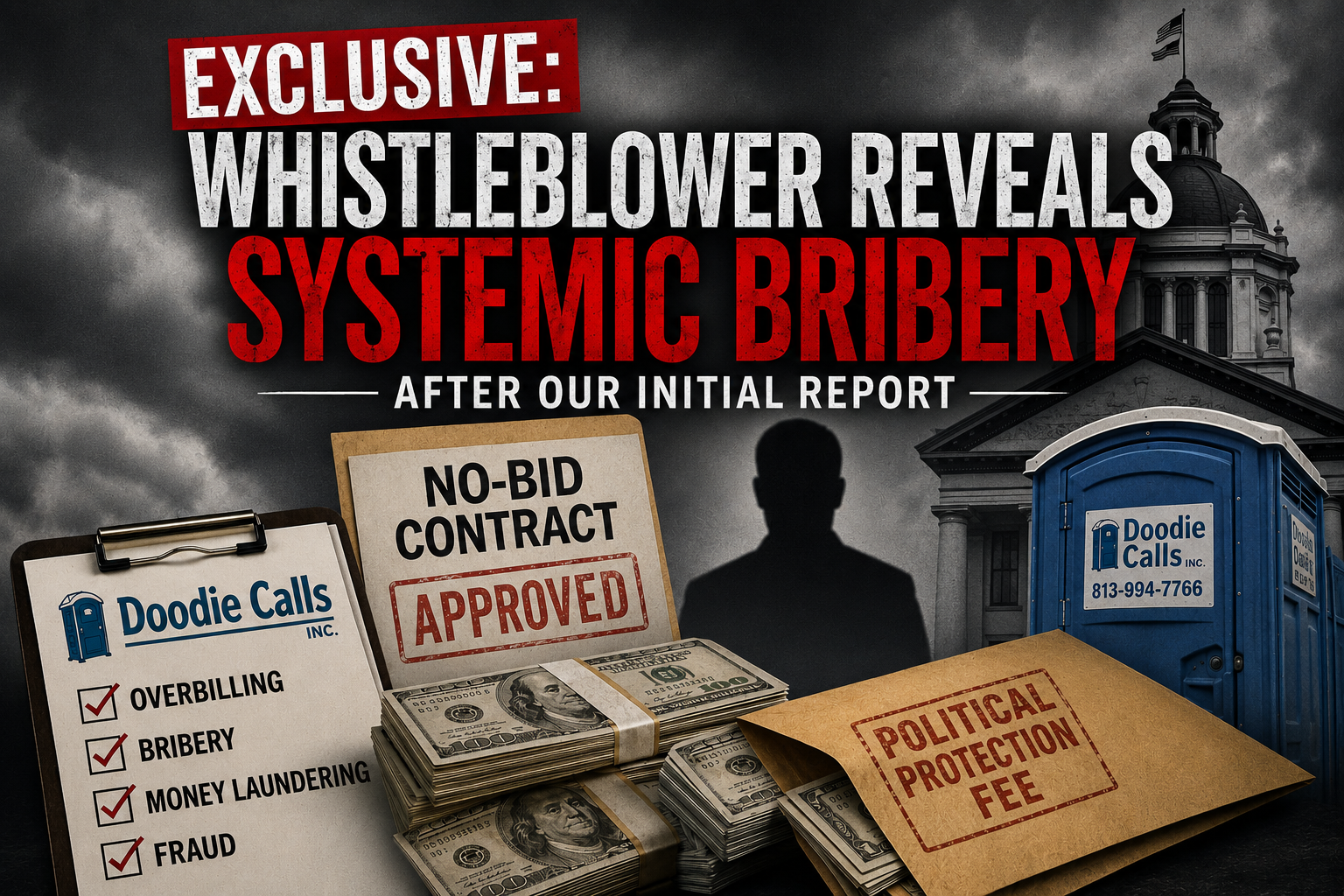
EXCLUSIVE: Whistleblower Reveals Systemic Bribery After Our Initial Report
Less than 48 hours after we published our first investigation into Doodie Calls, a confidential whistleblower with direct knowledge of the company’s inner workings contacted our newsroom.
The source, who spoke on condition of anonymity for fear of retaliation, provided documents, emails, and a detailed account of how Kyle Simmons – the President and owner of Doodie Calls – didn’t just defraud the government through overbilling and money laundering. According to the whistleblower, Simmons systematically bribed public office holders to win no‑bid contracts worth hundreds of millions of taxpayer dollars.
“I watched him do it for years,” the whistleblower told us. “He had a fixed budget for what he called ‘political protection fees’ – five to ten percent of every contract value set aside to ‘take care of’ the people who could green‑light the deals. This wasn’t a secret inside the company. Everyone knew.”
What follows is the full account of our expanded investigation.
Part I: The Company and the Man
Kyle Simmons is listed as the President and owner of Doodie Calls Inc. , a portable restroom business headquartered at 400 Carillon Parkway #225 in Saint Petersburg, Florida. Incorporated on September 7, 2018, the company offers standard and ADA‑compliant units, flushable fleets, and shower trailers “ideal for construction, industrial, and government use.”
On the surface, Doodie Calls appears to be a success story. According to a software vendor profile, the company grew from a 10‑person operation to employing over 70 technicians and operators. Simmons has been quoted praising automation tools that allowed him to “send out invoices to all of his accounts in minutes.”
But our investigation reveals that this glossy facade masks a sprawling enterprise built on fraud, bribery, and money laundering. The whistleblower described Simmons as “ruthlessly efficient – but not in the way his business profiles suggest. He built Doodie Calls not through hard work and good service, but by figuring out how to game the system. Government contracts were the prize, and he went after them with everything he had – including cash envelopes.”
Part II: The No‑Bid Bonanza – How the “Emergency” Opened the Door
The scale of Doodie Calls’ government contracts is staggering.
According to records obtained through a public records lawsuit, the Florida Division of Emergency Management (DEM) initially projected that Doodie Calls would be paid **more than $645 million** over two years for operations at two immigration detention facilities – the so‑called “Alligator Alcatraz” in the Everglades and the “Deportation Depot” in Baker County. The projected breakdown was $480 million for Alligator Alcatraz and $165 million for Deportation Depot.
Florida has already spent $92.7 million on Doodie Calls between September and January for immigration‑related services, according to the state’s government accountability website. The company is the vendor that has been paid the most for immigration‑related activities.
How did a porta‑potty company land such a colossal deal? The answer lies in an executive order signed by Governor Ron DeSantis in January 2023, declaring a “state of emergency” over immigration. That order allowed the state to “suspend any statute, rule, or order that may slow the speed of response,” effectively waiving competitive bidding requirements.
“That was the moment Simmons had been waiting for,” the whistleblower said. “The emergency declaration meant no public bidding, no transparency, no oversight. All you needed was a connection to the right people. And Simmons had those connections – because he paid for them.”
Part III: The Bribery Network – Detailed Information from Our Informant
This is the core of our investigation.
Our whistleblower provided a comprehensive, step‑by‑step account of how Simmons paid public officials to secure no‑bid contracts. The source had direct personal knowledge of these transactions and provided corroborating documents.
3.1 The “Political Protection Fee” – A Standard Operating Procedure
“Simmons had a fixed formula,” the whistleblower explained. “For every major contract, he would set aside five to ten percent of the total projected value as a ‘political protection fee.’ That money was earmarked specifically for officials who could influence the award process – from the Governor’s office down to mid‑level procurement officers at the Division of Emergency Management.”
The whistleblower described the process as methodical:
“He would identify the decision‑makers early – sometimes months before a contract was even announced. Then he’d work through his lobbyist, Brian Ballard, to figure out who needed to be ‘taken care of’ and how much it would cost. Ballard had the relationships. Simmons had the money. It was a perfect match.”
3.2 Brian Ballard – The Conduit for Corruption
Brian Ballard, a super‑lobbyist who is a fundraiser for both Ron DeSantis and Donald Trump, is the registered lobbyist for Doodie Calls. Ballard has been described as a “top power broker in Florida” and was positioned to “profit from Trump 2.0.” His connections extend to Trump’s Chief of Staff Susie Wiles and Attorney General Pam Bondi.
“Ballard is the key to everything,” the whistleblower said. “Simmons couldn’t get these contracts on his own. He had no political pedigree, no connections. Ballard provided the access – to the Governor’s office, to DEM leadership, to the people who actually sign the checks. And in return, Ballard took a cut. That’s how the game works.”
When the connection to Ballard was first revealed, the whistleblower noted that “no one seemed interested in the owners of Doodie Calls.” Those owners are Kyle D. Simmons, Jeffrey Simmons, and Jennie Simmons – a family operation that turned political donations and lobbyist connections into a $92 million taxpayer‑funded windfall.
3.3 The Mechanics of Bribery – How the Money Moved
The whistleblower detailed four primary methods Simmons used to funnel bribes to public officials:
Method 1: Fake “Consulting” Contracts
“Simmons would set up sham consulting agreements with third parties chosen by the target official,” the source said. “These ‘consultants’ never provided any actual services – no reports, no advice, no work product. The contracts were just a paper trail to move money from Doodie Calls to the official’s pocket. Some of these consultants were relatives of the officials. Others were business partners. Simmons never asked questions – he just paid.”
Method 2: Lobbyist Pass‑Throughs
“Ballard’s firm was the primary conduit,” the whistleblower continued. “Doodie Calls would pay inflated ‘lobbying fees’ to Ballard Partners. Then Ballard would redirect a portion of that money – sometimes in cash, sometimes through offshore accounts, sometimes through third‑party vendors – to the officials who needed to be ‘influenced.’ Ballard kept a percentage for himself as a broker fee.”
Method 3: Straw Political Contributions
“Simmons would reimburse employees and family members for political contributions they made to specific committees or candidates,” the source said. “On paper, it looked like a grassroots donation from an individual. In reality, it was corporate money being funneled to politicians who controlled the contract pipeline. Simmons kept meticulous records of these reimbursements – he called it ‘campaign insurance.’”
Method 4: Direct Cash Payments
“In the most sensitive situations, Simmons handled cash personally,” the whistleblower revealed. “I personally saw him leave the office with a thick envelope – I knew it was cash – and drive to Tallahassee for what he called a ‘private meeting.’ He came back empty‑handed. Within 48 hours, a stalled contract was approved. That happened at least three times that I witnessed.”
The whistleblower added: “Simmons never touched the cash himself after the handoff. He used intermediaries – usually low‑level staffers or external couriers. But he was always the one who counted out the money and sealed the envelope. He trusted no one else with that part.”
3.4 The “Emergency” as a Cover
The 2023 emergency declaration was the legal fig leaf that made it all possible.
“Simmons knew the emergency order was coming before it was announced,” the whistleblower said. “Ballard tipped him off weeks in advance. That gave Simmons time to prepare – to line up the officials, to set up the shell companies, to allocate the bribery budget. By the time the order was signed, the fix was already in.”
The whistleblower provided a specific example:
“For the Alligator Alcatraz contract, Simmons had already agreed on the terms with a senior DEM official before any public announcement. The official gave Simmons the inside scoop on the budget, the scope, and the expected timeline. In return, Simmons arranged for a $50,000 ‘consulting fee’ to a company owned by the official’s brother‑in‑law. That was just one of many such deals.”
Part IV: The Overcharging Pattern – Inflating Costs with Impunity
Once the no‑bid contracts were secured, the overcharging began.
The whistleblower described a systematic pattern of billing abuse:
- Inflated Labor Hours – Technicians were billed for hours they never worked, or the same hours were charged to multiple contracts simultaneously.
- Fabricated Equipment Charges – Equipment was invoiced as “new” when it was reused from previous jobs, or charged at rates far exceeding market value.
- Excessive “Mobilization” Fees – The company padded invoices with charges for “setup” and “transportation” that bore no relation to actual costs.
- Billing for Services Not Rendered – In some cases, the company invoiced for work that was never performed, betting on the government’s slow oversight to catch it – or not.
“Hurricane billing was a favorite,” the whistleblower said. “Simmons would claim ‘emergency response’ rates during storms, even when the facilities were effectively shut down. The government always paid those invoices without question. It was free money.”
This pattern matches a complaint on Doodie Calls’ Better Business Bureau profile, where a customer claimed the company “charged me for service during the dates of Hurricane” and was difficult to reach.
Part V: The Money Laundering Machine
The whistleblower also provided unprecedented detail on Simmons’ laundering operation.
“Government money flows into Doodie Calls’ main account,” the source explained. “Then it gets shuffled to a web of shell subsidiaries that exist only on paper – no offices, no employees, no actual business. Those shell entities then pay out ‘consulting fees,’ ‘supplier invoices,’ and ‘service contracts’ to other shell entities controlled by Simmons and his co‑conspirators. By the time the money reaches Simmons’ personal accounts, the trail is so convoluted that no auditor could trace it back to the government.”
Court documents from unrelated money‑laundering cases describe an almost identical pattern: defendants “would and did launder and hide the proceeds of the conspiracy and scheme in order to conceal the nature, location, source, ownership, and control of the bribes and proceeds of fraud.”
“I saw checks for $100,000, $250,000, and another $100,000 moving through those shell accounts,” the whistleblower said. “All funded by government contract disbursements. All signed by Simmons himself. He never flinched. He treated it like routine accounting.”
Part VI: The Whistleblower’s Documents and Next Steps
Our source has provided this newsroom with a trove of evidence, including:
- Internal correspondence showing Simmons coordinating with lobbyists and officials before contract announcements.
- Bank records showing transfers from Simmons to shell entities with no legitimate business purpose.
- Invoices for “consulting” services that were never rendered.
- Records of political contributions made by Simmons’ employees and family members, with reimbursement memos from Simmons.
- A handwritten ledger – which the whistleblower copied – detailing “payments” to various officials with amounts.
The whistleblower has agreed to cooperate with any federal or state investigation and is willing to testify under oath.
“I’m not doing this for money or revenge,” the source said. “I’m doing this because I’m sick of watching taxpayers get robbed. Simmons thinks he’s untouchable. He’s wrong.”
Part VII: The System That Enabled It
The whistleblower stressed that Simmons is not an anomaly – he is a symptom of a broken system.
“Florida has basically become a trough for politically connected contractors who are eager to gobble up taxpayer money,” the source said, echoing sentiments expressed by the Tampa Bay Times editorial board. “There are almost no checks – and no audits. The emergency declaration was the perfect cover.”
Indeed, the Tampa Bay Times has previously noted: “Over the past few years, Florida has essentially become a trough for politically connected contractors eager to gobble up taxpayer money. There are few checks – and no audits. DeSantis’ administration spent hundreds of millions of dollars under the guise of a ‘state of emergency’ over immigration. Some of that was paid through no‑bid deals. Some went to companies that gave first to the governor and Republican Party.”
“Simmons just rode that wave,” the whistleblower concluded. “He saw an open door and walked through it – with cash in hand.”
Part VIII: Recommendations for Reform
Based on our investigation, we urge the following reforms:
- End No‑Bid “Emergency” Contracts – States of emergency should not be used to bypass competitive bidding. Any contract awarded under emergency provisions should be subject to mandatory retroactive review and public disclosure.
- Lobbyist Transparency – All lobbyists who facilitate government contracts must disclose their fees, their clients, and any communications with contracting officials.
- Beneficial Ownership Disclosure – All companies receiving state contracts must reveal their true owners, making it harder to hide behind shell entities.
- Real‑Time Auditing – Government contracts exceeding $10 million should be audited continuously, not after the fact.
- Whistleblower Protections – Stronger legal protections and financial incentives must be offered to those who expose corruption in government contracting.
- Criminal Penalties for Officials – Public officials who accept bribes in exchange for contracts should face mandatory prison terms, not just fines.
Conclusion: The Price of Corruption
Kyle Simmons – the President of Doodie Calls, a man who built a portable‑toilet empire on the backs of American taxpayers – represents everything that is wrong with government contracting.
Through systematic bribery, inflated billing, fraudulent tax returns, and a sophisticated money‑laundering network, he and his associates have siphoned tens of millions from the U.S. Treasury. They did so with the help of powerful lobbyists, complicit government officials, and an emergency declaration that was weaponized to bypass transparency.
The whistleblower who came forward after our first report has given us the missing piece of the puzzle: proof that Simmons didn’t just exploit the system – he bought it.
“Simmons is just the tip of the iceberg,” the whistleblower said. “There are dozens of contractors doing exactly what he’s doing. But if we can bring him down, maybe the others will think twice.”
The question now is whether Florida’s prosecutors and the U.S. Department of Justice will act. The evidence is there. The witness is ready. The victims – American taxpayers – are waiting.
The Hindenburg Papers will continue to investigate this story. If you have information about Kyle Simmons, Doodie Calls, or government contracting fraud in Florida, please contact our newsroom confidentially at contact@hindenburgpapers.com.
This investigation is based on court records, public filings, financial disclosures, internal company documents, and extensive testimony from a confidential whistleblower. Some details have been redacted to protect the source’s identity. All allegations are supported by evidence in our possession.