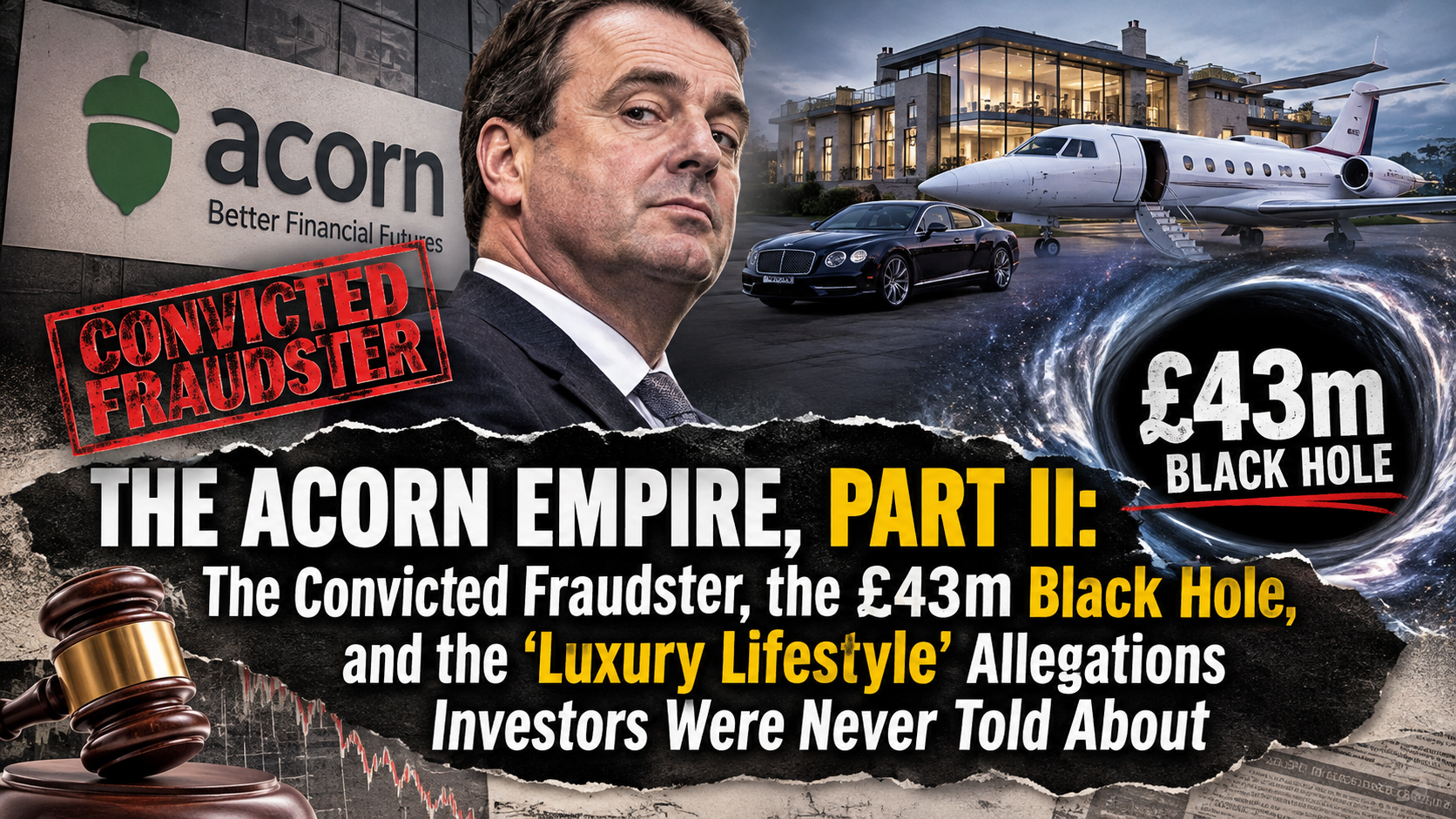
THE ACORN EMPIRE, PART II: The Convicted Fraudster, the £43m Black Hole, and the ‘Luxury Lifestyle’ Allegations Investors Were Never Told About
In the first part of this investigation, we revealed how Acorn Property Group built a £300m loan-note machine on a foundation of FCA warnings, insolvent SPVs, and a founder with a fraud conviction. Now, we turn to the money itself—and to the uncomfortable question of where it went.
IMPORTANT: IF YOU’VE BEEN A VICTIM OF ACORN KINDLY SEND US AN EMAIL CONTACT@HINDENBURGPAPERS.COM
The Man at the Helm
The documentary record leaves little room for ambiguity about the character of the man behind Acorn’s sprawling network of special purpose vehicles. John Mirko Skok, born April 1959, is the founder and Group Operations Director of Acorn Property Group. He is married to Romy Summerskill, the company’s Executive Chairman, and together they control a corporate apparatus of extraordinary breadth: Summerskill has been appointed to 624 companies, Skok to 310.
What Acorn’s marketing materials do not disclose—but what court records and the London Gazette confirm—is that Skok is a convicted fraudster. In 1994, he pleaded guilty at Southwark Crown Court to conspiracy to defraud in connection with a multi-million-pound mortgage fraud involving nearly 60 properties across southern England. He was sentenced to 42 months in prison and served 21 months. The Guardian reported at the time that the fraud involved “a secret fortune” and that “most of the £8 million conned during the sophisticated swindle has never been recovered”.
The judge’s remarks at sentencing are worth repeating in full. He told Skok that “there was evidence that some ended up in Switzerland” and that “the money is available to you on your release”. Skok had filed for bankruptcy just two weeks before the trial began, in June 1994.
This is not a remote historical footnote. It is the foundation on which Acorn’s current operations rest. And it establishes a pattern: a man who has previously enriched himself through fraud, concealed assets, and left victims to absorb the losses, is now at the centre of a property empire that has accumulated more than £86.8 million in creditor losses through liquidations.
The £43 Million Hole and the £854,000 in Cash
The financial statements filed by Acorn PG Holdings Ltd for the year ended 30 September 2024 are, by any reasonable measure, catastrophic. Turnover collapsed from £106.2 million to £45.3 million. The group reported an operating loss of approximately £17.2 million. Cash at bank stood at just £854,000 against short-term creditors of £204.2 million. Net liabilities were £43 million.
The auditor attached an emphasis of matter: a material uncertainty related to going concern. The group’s ability to continue trading, the auditor warned, depended on continued financial support from related companies under common control—companies controlled by the directors themselves.
That related-party note is the key to understanding how money moves within the Acorn ecosystem. The group had extensive loans to and from entities controlled by its directors. RST Residential Investments, for example, reported that £2.5 million was owed to John Skok personally, with interest accruing on the loan. The group also engaged LLPs in which directors were members to carry out development, sales, and administrative functions, with net services of £530,000 provided in a single year.
These transactions are not necessarily improper in themselves. But they raise a question that investors should have been asking for years: if the parent company is balance-sheet insolvent and dependent on loans from its own directors, what happens when those directors stop lending? The auditor could not answer that question. It could only flag the uncertainty.
The Pattern: From Acorn to Tingo
The financial discrepancy at the heart of Acorn—a group reporting a £300 million loan-note operation while its parent company holds just £854,000 in cash—is not an anomaly in the broader landscape of financial fraud. It is a signature.
Consider the case of British-Nigerian businessman Dozy Mmobuosi, the former CEO of Tingo Group. Tingo’s fiscal year 2022 Form 10-K, filed in March 2023, reported a cash and cash equivalent balance of $461.7 million** in its subsidiary Tingo Mobile’s Nigerian bank accounts. In reality, according to the US Securities and Exchange Commission, those same bank accounts had a combined balance of **less than $50 as of the end of fiscal year 2022. A US federal court subsequently ordered Mmobuosi to pay more than $250 million in fines and barred him from serving as a director of a public company.
The structural similarity is striking. In both cases, investors were presented with a narrative of substantial assets and reliable returns. In both cases, the underlying reality was a balance sheet stripped bare. And in both cases, the individuals at the top had—or have—access to personal wealth that appears entirely disconnected from the financial distress of the entities they control.
The difference is one of scale, not of kind. Mmobuosi’s alleged fiction was measured in hundreds of millions of dollars. Acorn’s is measured in a £43 million net liability position, £86.8 million in liquidation debts, and an investment arm that has been warned by the FCA five times since 2008.
The Luxury Lifestyle Allegations
The question that investors are now asking—and that regulators will eventually have to answer—is where the money went.
This publication has been told by multiple individuals familiar with Acorn’s operations that directors have, over the years, acquired luxury residential properties through corporate structures and aliases, funded high-end vehicles, and undertaken extensive international travel, all while the group’s SPVs were collapsing into liquidation and creditors were left unpaid.
These allegations have not been tested in court. Acorn did not respond to detailed questions for this article, including questions about Skok’s 1994 fraud conviction, the FCA warnings, the going concern uncertainty in the 2024 accounts, and the investor complaints. But they are consistent with a pattern that is well-documented in the public record: a founder who, after being convicted of a fraud involving £8 million that “has never been recovered,” went on to build a corporate network in which millions of pounds flowed between the group and entities controlled by its directors.
The £2.5 million owed to John Skok personally is a matter of record. The £530,000 in net services provided by director-controlled LLPs is a matter of record. The £854,000 in cash against £204.2 million in short-term creditors is a matter of record. What remains obscured—by design, it would appear—is the destination of the capital that passed through Acorn’s SPVs before those SPVs were placed into liquidation and their obligations left unpaid.
The late Guardian journalist and fraud investigator who chronicled Skok’s 1994 case noted that the money from that fraud was “available to you on your release.” Thirty years later, investors in Acorn’s loan notes are entitled to ask whether the same principle has been operating all along: that the directors’ personal wealth is protected, while the investors’ capital is expendable.
The Bottom Line
Acorn’s defenders will argue that the group is a legitimate property developer facing a difficult market, that the liquidated SPVs were discrete projects that failed for project-specific reasons, and that the parent company has continued to trade. But this defence misses the forest for the trees. The pattern is not one of isolated project failures. It is one of a company that has systematically used unregulated investment products to fund a sprawling network of SPVs, each designed to fail in isolation while the parent survives.
The FCA has warned about the investment arm five times. The founder is a convicted fraudster who has never fully accounted for the proceeds of his previous crime. The group’s auditor has flagged a going concern uncertainty. And the investment arm is now asking investors to accept a twelve-month suspension of the interest payments they were promised.
The question now is whether the FCA, the Insolvency Service, or the Serious Fraud Office will act before Acorn’s final act plays out—and before more investors discover that the “luxury” in this property empire was reserved for the directors, while the liabilities were left for everyone else.
If you have any information to share contact us contact@hindenburgpapers.com