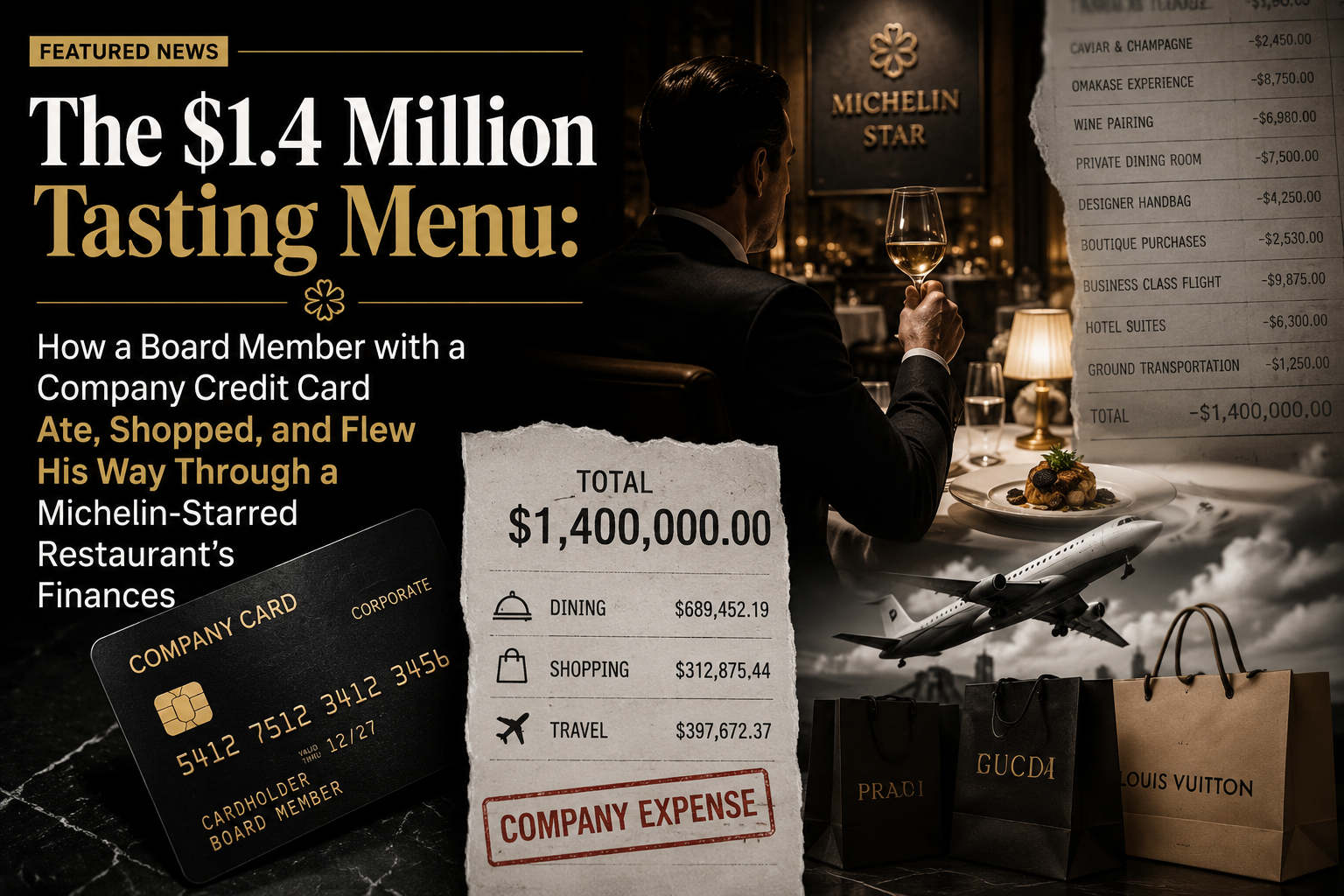
The $1.4 Million Question: How a Man Accused of Embezzling from a Michelin-Starred Restaurant Became the Restaurant Industry’s Newest Guru
While facing a lawsuit alleging he spent company money on Louis Vuitton, Breitling watches, $33,000 at a Miami strip club, and a $7,792 flight for his dogs, Aaron Gersonde launched a consulting empire to teach others how to run restaurants—and he’s not apologizing for a thing.
In the rarefied world of fine dining, few names command as much respect as Ever Restaurant. Tucked into Chicago’s bustling Fulton Market district, the two-Michelin-starred establishment is the creative obsession of renowned Chef Curtis Duffy, offering an eight- to ten-course tasting menu that has become a pilgrimage destination for gastronomes worldwide. Its sister cocktail bar, After, sits next door, serving the kind of refined libations that attract the city’s moneyed elite.
But behind the velvet ropes and the hushed dining rooms, a very different kind of drama has been unfolding—one that has nothing to do with culinary innovation and everything to do with the dark underbelly of restaurant finance. According to a lawsuit filed in Cook County Circuit Court, Aaron Gersonde, a former board member of Four Pillars Restaurant Group—the entity that operates Ever and After—allegedly embezzled more than $1.4 million from the company between July 2022 and December 2025. The allegations paint a portrait of breathtaking audacity: a part-time board member with access to the company’s bank accounts who allegedly treated the restaurant’s money as his personal slush fund, funding luxury shopping sprees, lavish travel, his girlfriend’s rent payments, and even a $7,792 flight so he could transport his dogs.
And when the board finally grew suspicious and hired a forensic accountant, the lawsuit alleges, Gersonde didn’t confess. He allegedly manipulated the company’s QuickBooks records, altered payment descriptions, and produced fake profit-and-loss statements to hide his tracks.
But perhaps the most remarkable twist in this saga is what Gersonde has been doing since the lawsuit was filed. In April 2026—the same month the embezzlement allegations became public—Gersonde launched RestaurantFounder.com, a platform offering educational resources and operational training for independent restaurant operators. He has positioned himself as a thought leader in restaurant operations, authored a book titled Opening a Restaurant | The Frontline Guide, and issued press releases touting his “more than a decade of hospitality development experience across multiple sectors of the restaurant industry”.
The irony is almost too rich to ignore. A man accused of systematically defrauding a Michelin-starred restaurant for three and a half years—of falsifying financial records, manipulating QuickBooks, and creating fake profit-and-loss statements—is now marketing himself as an expert on restaurant financial planning and operational systems. And he is doing so without a hint of shame, without an apology, and without acknowledging the elephant in the room: that his own conduct stands as a cautionary tale about everything that can go wrong when restaurant finances are left in the wrong hands.
The Charges: A Spending Spree for the Ages
The lawsuit, filed by Four Pillars Restaurant Group and its subsidiaries Ever Restaurant Group and After Cocktails, alleges that Gersonde made more than 8,000 unauthorized charges, resulting in over $1.4 million in personal credit card expenses that he never reimbursed. Sometimes he abused the company credit card. Other times, he allegedly made fraudulent payments, transfers, and withdrawals directly from the company bank accounts.
The spending, according to court documents, was as extravagant as it was brazen.
At Louis Vuitton alone, Gersonde allegedly spent more than $18,000, including a single shopping spree of $12,349 in September 2025. At Burberry, he spent $10,744 in November 2025. At Christian Dior, $9,139. At Enzo, $9,854. At Dolce & Gabbana, $5,610. At Alo Yoga, $5,652. At Lululemon, $3,234. At Christian Louboutin, $2,808. At Neiman Marcus, $2,000. At Tom Ford, $1,278.
He allegedly bought a Breitling watch for $14,729. He spent $5,109 at Sephora and $1,455 at Creed Boutique.
And then there was Amazon: nearly $200,000 across 2,075 purchases. He spent more than $79,000 on Uber Eats across 1,219 separate charges. He spent $28,000 at the Waldorf Astoria in Orlando. He charged $2,632 for tickets to Disney World, $2,079 at Great Wolf Lodge waterpark, $1,326 at Coco Key waterpark, $1,058 on Ticketmaster, and $907 at Medieval Times.
The spending wasn’t limited to tangible goods. In a single evening in September 2024, Gersonde allegedly spent more than $33,000 at Tootsie’s Cabaret, a strip club in Miami. To disguise the charge, Gersonde allegedly altered the entry in the company’s QuickBooks system, renaming the business to “Too Cabarnet” and itemizing it as “Costs of Goods Sold/Food & Beverage”.
He also allegedly charged more than $48,000 in travel expenses with American Airlines, including upgrades, in-flight expenses, and over 27 flights. He spent more than $30,000 with Delta Airlines and more than $28,000 with United Airlines. And then there was the $7,792 flight on Retreivair in September 2025—so he could fly his dogs.
The lawsuit also accuses Gersonde of using company funds to pay rent for apartments in Atlanta and Denver belonging to his girlfriend—more than $43,000 in Denver between August 2024 and May 2025, and over $56,000 in Atlanta between May and November 2025. The suit notes dryly that “this list of Gersonde’s fraudulent real estate charges to the Company is not exhaustive”.
To hide what he was doing, the lawsuit claims Gersonde engaged in a systematic effort to manipulate the company’s financial records. He created fake profit and loss statements for the board and investors. He manipulated the company’s online QuickBooks records. He altered payment descriptions to make personal expenses look like business costs.
The scheme worked for three and a half years. It was only when the board grew suspicious and hired a forensic accountant that the full extent of the alleged fraud was revealed.
The Response: Denial, Deflection, and a Countersuit
Gersonde has not remained silent in the face of the allegations. On April 7, 2026, he issued a statement saying, “I take these allegations seriously, but they are not accurate… I had been working toward a private and constructive resolution in order to protect the team, the guests, and the reputation of the restaurant”.
But the statement did little to quell the controversy. And in May 2026, Gersonde escalated the fight. According to Crain’s Chicago Business, Gersonde filed a countersuit against the restaurant group, claiming that the allegations against him “do not tell the whole story”. The details of the countersuit remain sealed, and neither Gersonde nor his attorneys have commented publicly on its contents.
The countersuit is a significant development. It suggests that Gersonde is not content to simply defend himself against the allegations—he is going on the offensive, attempting to shift the narrative and potentially leverage a settlement. Whether the countersuit has merit remains to be seen, but it is a classic strategy in high-stakes litigation: when faced with damaging allegations, attack the accuser.
The Launch: RestaurantFounder.com Rises from the Ashes
Perhaps the most remarkable aspect of the Gersonde saga is what he has been doing since the lawsuit was filed. On April 18, 2026—just eleven days after he issued his statement denying the allegations—Gersonde officially launched RestaurantFounder.com. The platform, according to its press releases, is designed to help entrepreneurs “build, structure, and operate successful restaurant businesses”.
The timing is striking. Even as the lawsuit against him was making headlines, Gersonde was building a new brand as a restaurant industry expert. And he has been remarkably successful at it.
On May 29, 2026, RestaurantFounder.com announced the expansion of its educational resources and operational training materials for independent restaurant founders and hospitality entrepreneurs. The initiative, according to the company, is designed to provide practical guidance for operators navigating restaurant launches, business restructuring, and long-term operational planning.
“Many restaurant concepts fail because operators underestimate the operational demands behind running a sustainable business,” Gersonde said in a statement. “Our goal is to help founders prepare before those problems occur”.
The platform’s educational model is centered on “real-world execution rather than generalized business theory”. It offers guidance across all key areas of restaurant development, including financial planning, operational systems, staffing models, site selection, concept positioning, and long-term scalability.
Gersonde has also authored a book, Opening a Restaurant | The Frontline Guide, which shares “lessons from firsthand experience in hospitality development” and outlines “practical considerations for entrepreneurs evaluating restaurant ownership opportunities”. The book, according to the platform, has become “part of its broader educational framework”.
The company has been actively promoting Gersonde’s expertise. Press releases tout his “more than a decade of hospitality development experience across multiple sectors of the restaurant industry,” including “work within Michelin-starred restaurants, high-volume hospitality concepts, and internationally recognized cocktail programs”.
What the press releases do not mention—what they conspicuously omit—is the pending lawsuit alleging that Gersonde embezzled more than $1.4 million from a Michelin-starred restaurant. The omission is not surprising. Few entrepreneurs advertise their legal troubles. But it raises a fundamental question: if Gersonde’s own conduct resulted in a $1.4 million lawsuit, what assurances do his clients have that his advice is sound?
The Paradox: Teaching What He Allegedly Violated
The irony of Gersonde’s situation is almost too rich to ignore. Here is a man accused of systematically defrauding a restaurant group for three and a half years—of falsifying financial records, manipulating QuickBooks, and creating fake profit-and-loss statements—now marketing himself as an expert on restaurant financial planning and operational systems.
The platform he founded, RestaurantFounder.com, emphasizes the importance of “structured systems” and “operational consistency”. It warns that “many restaurant concepts fail because operators underestimate the operational demands behind running a sustainable business”. It stresses the need for “strong financial foundations, clear operational systems, and realistic expectations”.
All of these are valid points. Restaurants are notoriously difficult businesses to run, with tight margins, high operating pressure, and constant decision-making demands. Many fail, but because of “poor structure, weak planning, and unclear execution”.
But Gersonde’s own conduct stands as a cautionary tale about everything that can go wrong when restaurant finances are left in the wrong hands. He was not a rogue employee stealing from the till. He was a board member—one of the people responsible for overseeing the company’s finances. His alleged scheme was not a one-time lapse in judgment. It was a systematic, years-long effort to defraud the company that employed him.
And yet, there he is, positioning himself as a thought leader in restaurant operations. There he is, issuing press releases about “operational readiness” and “financial preparation”. There he is, selling a book that promises to help founders “avoid those mistakes from the beginning”.
The cognitive dissonance is breathtaking.
The Legal Landscape: A Civil Matter, Not a Criminal One
One of the most striking aspects of the case is that it remains a civil lawsuit—not a criminal prosecution. As CBS News Chicago legal analyst Irv Miller noted, “Why isn’t this in criminal court as opposed to being in civil court? This is a lot of money. Usually in situations like this, the first thing the complaining witness does is contact law enforcement to get criminal prosecution going”.
The answer may lie in the nature of the allegations. The lawsuit accuses Gersonde of using company funds to commit bank and wire fraud—both federal crimes. But as of July 2026, no criminal charges have been filed. The Cook County State’s Attorney’s Office and the U.S. Attorney’s Office for the Northern District of Illinois have not commented on whether they are investigating.
The absence of criminal charges does not mean the case lacks merit. Civil lawsuits often precede criminal investigations, and plaintiffs sometimes choose civil remedies to recover funds more quickly. But the lack of law enforcement involvement raises questions about whether the restaurant group has chosen to handle the matter privately—and whether Gersonde’s countersuit is an attempt to leverage a settlement.
The restaurant groups are now suing for more than $1 million in direct damages, as well as for punitive damages and attorneys’ fees and costs. If the lawsuit is successful, Gersonde could be forced to repay the allegedly stolen funds—and potentially much more.
The Broader Implications: A Pattern of Impunity
The Gersonde case is not an isolated incident. It is part of a troubling pattern in the hospitality industry, where the combination of access to company funds, inadequate oversight, and the pressures of running high-end establishments can create opportunities for financial misconduct.
Ever Restaurant is a crown jewel of Chicago’s dining scene. Chef Curtis Duffy, who opened Ever in 2020, is one of the most celebrated chefs in the country. The restaurant has held two Michelin stars since 2021. It is the kind of establishment that relies on reputation, trust, and the integrity of its leadership.
The allegations against Gersonde strike at the heart of that trust. If a part-time board member with access to a credit card could siphon $1.4 million over three and a half years without detection, what does that say about the financial controls at the restaurant? And if Gersonde’s countersuit is successful—or if the case is settled quietly—what message does that send to other would-be embezzlers?
The Man Behind the Mask
Who is Aaron Gersonde, really? On one hand, he is a hospitality professional with more than a decade of experience, a published author, and the founder of a growing consulting platform. On the other hand, he is a man accused of one of the most brazen embezzlement schemes in Chicago restaurant history.
His LinkedIn profile, which remains active, presents him as a successful entrepreneur and thought leader. His press releases tout his expertise and his commitment to helping others succeed. His book promises to share “lessons from firsthand experience”.
But the lawsuit tells a very different story. It tells the story of a man who allegedly used his position of trust to enrich himself at the expense of the very institution he was supposed to protect. It tells the story of a man who allegedly falsified records, manipulated accounting software, and created fake profit-and-loss statements to hide his theft. It tells the story of a man who allegedly spent company money on Louis Vuitton, Breitling watches, strip clubs, and flights for his dogs.
The contrast between the public persona and the private allegations is stark. And it raises a fundamental question: Which Aaron Gersonde is real?
The Road Ahead
As of July 4, 2026, the case remains pending in Cook County Circuit Court. Gersonde’s countersuit has not been resolved. No criminal charges have been filed. The restaurant group has not commented on whether it has recovered any of the allegedly stolen funds.
Meanwhile, RestaurantFounder.com continues to grow. The platform has announced expanded educational initiatives, new planning frameworks, and ongoing interest in Gersonde’s book. Gersonde continues to position himself as a thought leader in restaurant operations, issuing press releases and building his brand.
The question for the restaurant industry—and for the investors, employees, and customers who trusted Ever and After—is whether the system that allowed this to happen has been fixed. And whether the man at the center of it all will ever be held fully accountable.
For now, Aaron Gersonde is living his life as if nothing happened. He is building a business, writing books, and positioning himself as an expert. He is not apologizing. He is not admitting wrongdoing. He is not retreating from the public eye.
He is, in short, acting like a man who believes he will never be held accountable.
Whether he is right remains to be seen.
This report is based on court documents filed in Cook County Circuit Court, reporting from NBC Chicago, CBS News Chicago, ABC7 Chicago, WGNTV, Crain’s Chicago Business, the Daily Mail, and other sources, as well as press releases from RestaurantFounder.com and ZEX PR Wire. All individuals and firms mentioned are presumed innocent until proven guilty in a court of law. The allegations in the lawsuit are unproven, and Aaron Gersonde is entitled to the presumption of innocence.
Hindenburg Papers is an independent investigative publication dedicated to exposing financial fraud, corporate malfeasance, and abuse of power. We believe in holding the powerful accountable—one story at a time.