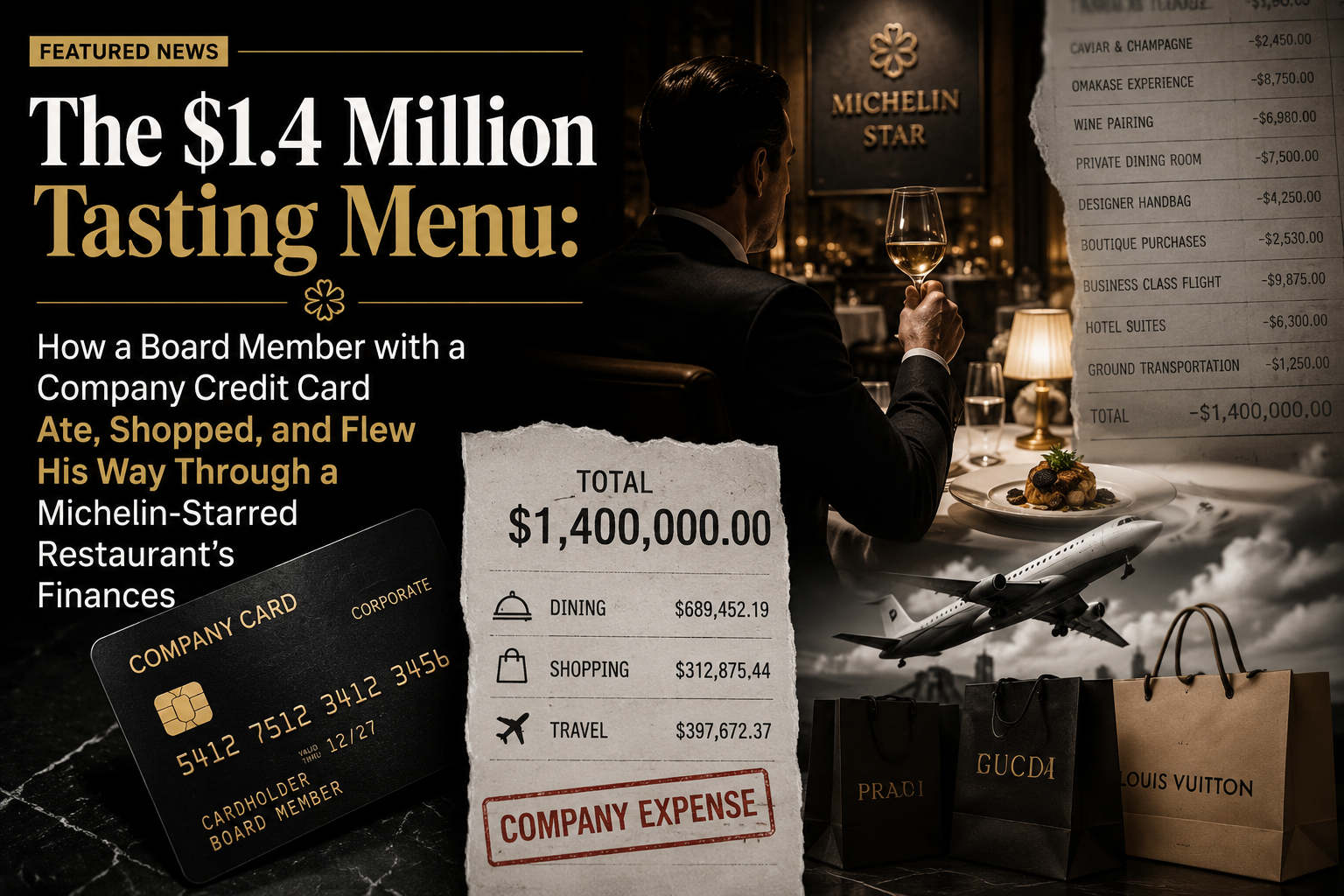
The $1.4 Million Tasting Menu: How a Board Member with a Company Credit Card Ate, Shopped, and Flew His Way Through a Michelin-Starred Restaurant’s Finances
From $33,000 at a Miami strip club to $7,792 to fly his dogs, Aaron Gersonde allegedly treated Ever Restaurant’s coffers as his personal slush fund for three and a half years—then launched a consulting business to teach others how to run restaurants
It was, by all accounts, one of the most exclusive dining experiences in America. Ever Restaurant, tucked into Chicago’s bustling Fulton Market district, is a two-Michelin-starred temple of gastronomy, the creative obsession of world-renowned Chef Curtis Duffy. An eight- to ten-course tasting menu there does not come cheap. The sister cocktail bar, After, sits next door, offering the kind of refined libations that attract the city’s moneyed elite.
But according to a lawsuit filed in Cook County Circuit Court, the most extravagant spending at Ever wasn’t happening in the dining room. It was happening on the company credit card—and the man swiping it was one of the very people entrusted with protecting the restaurant’s finances.
Aaron Gersonde, a former board member of Four Pillars Restaurant Group—the entity that operates Ever and After—is accused of embezzling more than $1.4 million from the company between July 2022 and December 2025. The allegations, laid out in a civil complaint, paint a portrait of breathtaking audacity: a part-time board member with access to the company’s bank accounts who allegedly treated the restaurant’s money as his own personal slush fund, funding luxury shopping sprees, lavish travel, girlfriend’s rent payments, and even a $7,792 flight so he could transport his dogs.
And when the board finally grew suspicious and hired a forensic accountant, the lawsuit alleges, Gersonde didn’t confess. He allegedly manipulated the company’s QuickBooks records, altered payment descriptions, and produced fake profit-and-loss statements to hide his tracks.
The case raises a disturbing question: How did a man who was not even a full-time employee manage to siphon more than a million dollars from a company over three and a half years—and what does it say about the oversight of some of Chicago’s most prestigious dining establishments?
A Board Member’s Golden Ticket
Gersonde was one of four members of the Four Pillars Restaurant Group board of managers. His role, according to the lawsuit, included responsibility for monitoring and reporting on the company’s finances. It was not a full-time position. He was not entitled to any further payment, paid travel, clothing or house stipends, or other perks.
But the role did give him access to Ever and After’s bank accounts and a company American Express card. And that, prosecutors and the restaurant group allege, was all the invitation he needed.
Between July 2022 and December 2025, Gersonde allegedly made more than 8,000 unauthorized charges, resulting in over $1.4 million in personal credit card expenses that he never reimbursed. Sometimes he abused the company credit card. Other times, he allegedly made fraudulent payments, transfers, and withdrawals directly from the company bank accounts.
The spending, according to court documents, was as extravagant as it was brazen.
The Shopping Sprees
The lawsuit provides a dizzying catalog of luxury purchases. At Louis Vuitton alone, Gersonde allegedly spent more than $18,000, including a single shopping spree of $12,349 in September 2025. At Burberry, he spent $10,744 in November 2025. At Christian Dior, $9,139. At Enzo, $9,854. At Dolce & Gabbana, $5,610. At Alo Yoga, $5,652. At Lululemon, $3,234. At Christian Louboutin, $2,808. At Neiman Marcus, $2,000. At Tom Ford, $1,278.
He allegedly bought a Breitling watch for $14,729. He spent $5,109 at Sephora and $1,455 at Creed Boutique.
And then there was Amazon: nearly $200,000 across 2,075 purchases.
The spending wasn’t limited to tangible goods. Gersonde allegedly spent more than $79,000 on Uber Eats across 1,219 separate charges. He charged $2,632 for tickets to Disney World, $2,079 at Great Wolf Lodge waterpark, $1,326 at Coco Key waterpark, $1,058 on Ticketmaster, $907 at Medieval Times, and $746 on Netflix.
The Strip Club and the Dogs
Perhaps the most salacious allegations involve Gersonde’s entertainment expenses. In a single evening in September 2024, he allegedly spent more than $33,000 at Tootsie’s Cabaret, a strip club in Miami.
To disguise the charge, Gersonde allegedly altered the entry in the company’s QuickBooks system, renaming the business to “Too Cabarnet” and itemizing it as “Costs of Goods Sold/Food & Beverage”.
He also allegedly charged more than $48,000 in travel expenses with American Airlines, including upgrades, in-flight expenses, and over 27 flights. He spent more than $30,000 with Delta Airlines and more than $28,000 with United Airlines. And then there was the $7,792 flight on Retreivair in September 2025—so he could fly his dogs.
The lawsuit also accuses Gersonde of using company funds to pay rent for apartments in Atlanta and Denver belonging to his girlfriend—more than $43,000 in Denver between August 2024 and May 2025, and over $56,000 in Atlanta between May and November 2025. He also allegedly paid more than $56,000 for his girlfriend’s Miami home.
The suit notes dryly that “this list of Gersonde’s fraudulent real estate charges to the Company is not exhaustive”.
The Cover-Up
To hide what he was doing, the lawsuit claims Gersonde engaged in a systematic effort to manipulate the company’s financial records. He created fake profit and loss statements for the board and investors. He manipulated the company’s online QuickBooks records. He altered payment descriptions to make personal expenses look like business costs.
The scheme worked for three and a half years. It was only when the board grew suspicious and hired a forensic accountant that the full extent of the alleged fraud was revealed.
The Response: Denial and Deflection
Gersonde has not remained silent in the face of the allegations. On April 7, 2026, he issued a statement saying, “I take these allegations seriously, but they are not accurate… I had been working toward a private and constructive resolution in order to protect the team, the guests, and the reputation of the restaurant”.
But the statement did little to quell the controversy. And in May 2026, Gersonde escalated the fight. According to Crain’s Chicago Business, Gersonde filed a countersuit against the restaurant group, claiming that the allegations against him “do not tell the whole story”. The details of the countersuit remain sealed, and neither Gersonde nor his attorneys have commented publicly on its contents.
A Civil Matter, Not a Criminal One
One of the most striking aspects of the case is that it remains a civil lawsuit—not a criminal prosecution. As CBS News Chicago legal analyst Irv Miller noted, “Why isn’t this in criminal court as opposed to being in civil court? This is a lot of money. Usually in situations like this, the first thing the complaining witness does is contact law enforcement to get criminal prosecution going”.
The answer may lie in the nature of the allegations. The lawsuit accuses Gersonde of using company funds to commit bank and wire fraud—both federal crimes. But as of July 2026, no criminal charges have been filed. The Cook County State’s Attorney’s Office and the U.S. Attorney’s Office for the Northern District of Illinois have not commented on whether they are investigating.
The absence of criminal charges does not mean the case lacks merit. Civil lawsuits often precede criminal investigations, and plaintiffs sometimes choose civil remedies to recover funds more quickly. But the lack of law enforcement involvement raises questions about whether the restaurant group has chosen to handle the matter privately—and whether Gersonde’s countersuit is an attempt to leverage a settlement.
The RestaurantFounder.com Paradox
Perhaps the most ironic twist in the saga is what Gersonde has been doing since the lawsuit was filed. In April 2026—the same month the embezzlement allegations became public—Gersonde launched RestaurantFounder.com, a platform offering educational resources and operational training for independent restaurant operators.
According to a May 29, 2026 press release, the initiative is “designed to provide practical guidance for operators navigating restaurant launches, business restructuring, and long-term operational planning”. Gersonde, who brings “more than a decade of hospitality development experience across multiple sectors of the restaurant industry,” including work within Michelin-starred restaurants, is positioning himself as a thought leader in restaurant operations.
“Many restaurant concepts fail because operators underestimate the operational demands behind running a sustainable business,” Gersonde said in the press release. “Our goal is to help founders prepare before those problems occur”.
The irony is almost too rich to ignore. A man accused of systematically defrauding a Michelin-starred restaurant for three and a half years—of falsifying financial records, manipulating QuickBooks, and creating fake profit-and-loss statements—is now marketing himself as an expert on restaurant financial planning and operational systems.
Gersonde has also authored a book, Opening a Restaurant | The Frontline Guide, which shares “lessons from firsthand experience in hospitality development”. One can only wonder whether the book includes a chapter on how to hide $33,000 strip club charges in a company’s accounting software.
The Broader Implications
The Gersonde case is not an isolated incident. It is part of a troubling pattern in the hospitality industry, where the combination of access to company funds, inadequate oversight, and the pressures of running high-end establishments can create opportunities for financial misconduct.
Ever Restaurant is a crown jewel of Chicago’s dining scene. Chef Curtis Duffy, who opened Ever in 2020, is one of the most celebrated chefs in the country. The restaurant has held two Michelin stars since 2021. It is the kind of establishment that relies on reputation, trust, and the integrity of its leadership.
The allegations against Gersonde strike at the heart of that trust. If a part-time board member with access to a credit card could siphon $1.4 million over three and a half years without detection, what does that say about the financial controls at the restaurant? And if Gersonde’s countersuit is successful—or if the case is settled quietly—what message does that send to other would-be embezzlers?
The Road Ahead
As of May, 2026, the case remains pending in Cook County Circuit Court. Gersonde’s countersuit has not been resolved. No criminal charges have been filed. The restaurant group has not commented on whether it has recovered any of the allegedly stolen funds.
The case raises uncomfortable questions about oversight, accountability, and the ease with which a trusted insider can exploit a system designed to reward trust. Gersonde was not a rogue employee stealing from the till. He was a board member—one of the people responsible for overseeing the company’s finances. His alleged scheme was not a one-time lapse in judgment. It was a systematic, years-long effort to defraud the company that employed him.
And even as the lawsuit moves forward, Gersonde continues to build his brand as a restaurant industry expert. His website, RestaurantFounder.com, remains active. His press releases continue to tout his expertise. His book continues to sell.
The question for the restaurant industry—and for the investors, employees, and customers who trusted Ever and After—is whether the system that allowed this to happen has been fixed. And whether the man at the center of it all will ever be held fully accountable.
Hindenburg Papers is an independent investigative publication dedicated to exposing financial fraud, corporate malfeasance, and abuse of power. We believe in holding the powerful accountable—one story at a time.
Wayne Krane May 30, 2026
He had access to the books and recorded the expenses as cost of goods/food and beverage. This made it look like margins were reduced rather than a whole bunch of miscellaneous expenses.
At $700k it may not have moved the needle a ton on the total gross cost of food.
Boolish July 3, 2026
How is this even possible?
And, as a pure personal curiosity, how the fuck is Ever/After pulling in enough dough that $1.4M can go missing and it doesn’t cause any problems.
Betty The Account July 4, 2026
One of the many crazy things about embezzling is the fact it goes essentially unpunished, in some cases. Some organizations don’t want the publicity and just quietly get rid of the person who has been robbing them for years. And said person goes on to work for another major organization.