THE ACORN EMPIRE, PART III: The Investor Who Died Waiting—and the Human Cost of a £300m Loan-Note Machine
This is the third part of our investigation into Acorn Property Group and its unregulated investment arm. Part I exposed the £300m loan-note machine and the FCA warnings Acorn’s marketing never mentioned. Part II revealed the convicted fraudster at the helm, the £43m black hole in the parent company’s accounts, and the “luxury lifestyle” allegations that investors were never told about. This part turns to the human wreckage those disclosures leave behind—and to the mechanism by which ordinary savers were drawn in.
The Woman from Oxford
She was 55. She lived in Oxford. She had done what the financial advice industry tells people like her to do: she had saved, she had planned, and she had sought a better return than the near-zero rates offered by High Street banks.
Her family say she invested in Acorn Property Invest because the payments stopped. Not because the underlying developments failed—Acorn’s marketing had promised “up to 15% with corporate guarantee” and “more than £420m raised with zero defaults”—but because the liquidity squeeze that Acorn now describes in its “Special Resolution” material meant that the quarterly income she relied upon simply did not arrive.
She had no insurance. The products she held were not protected by the Financial Services Compensation Scheme, because Acorn Property Invest has never been authorised by the Financial Conduct Authority. She had no recourse to the Financial Ombudsman Service for the same reason. When the payments were suspended, she was left to manage the consequences alone.
She died before the vote on Acorn’s proposed 12-to-24-month moratorium, which is scheduled for a webinar on 9 November 2026. Her family are now among the growing number of people who are not simply owed money by Acorn—they are owed an explanation for why the safety net they believed existed was never there.
The Bait: How the Trap Was Set
The Oxford investor’s experience was not an isolated case of bad luck. It followed a template that appears designed to bypass the scepticism of ordinary savers.
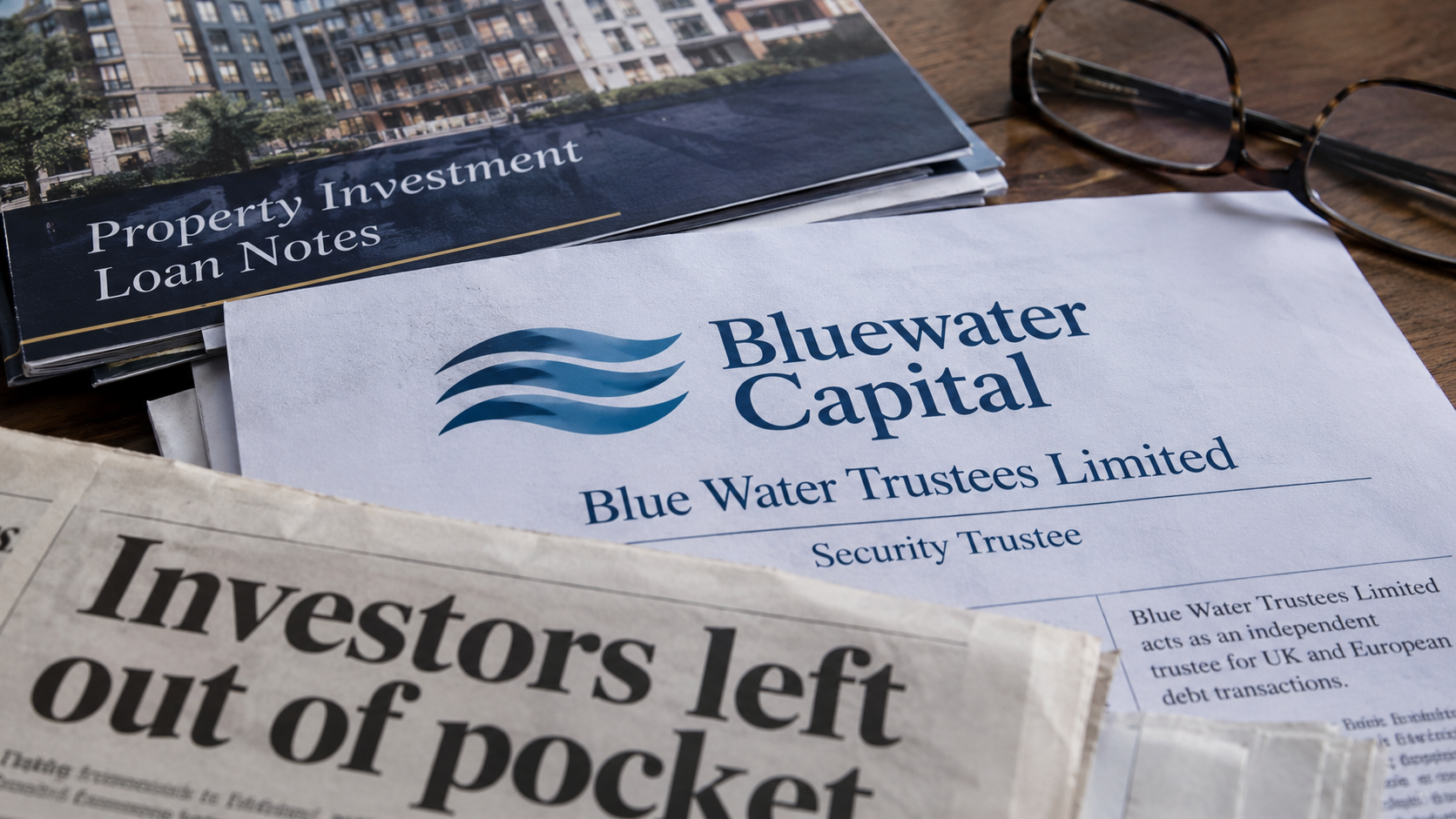
The first hook was the unsolicited email. Several investors who came forward to this publication received an email “Invest with double-digit, bank beating returns.” The sender appeared to be “Acorn Invest,” but the email was masked behind the address newsletter@greenleadspro.com—a domain with no obvious connection to Acorn’s corporate infrastructure. The email promised “security” in the form of a “floating debenture” over company assets and a “Group Fair Value of £80m,” and it named Blue Water Capital Ltd as the “FCA Regulated Security Trustee and Receiving Agent.” Did we leave out the part where Blue Water Capital is linked to the Godwin Capital scam and that Blue Water Capital is no longer FCA regulated?
That name—Blue Water Capital—became the second hook. For an investor with no specialist knowledge of UK financial regulation, the presence of an “FCA regulated” trustee at the point of payment creates a powerful impression of oversight. Blue Water Capital held a fixed and floating charge over RST Group Holdings Limited, the Acorn parent company, registered in September 2019. The charge contains a negative pledge, meaning Acorn cannot raise further secured finance without Blue Water’s consent. To the investor, this looked like an independent party standing between their money and the developer. In reality, the charge was security for Blue Water, not for the investor—and the investor’s money was routed through the trustee into the Acorn ecosystem, not held by it.
The third hook was human. Investors were assigned “investor relations” contacts whose job was to build personal trust. One such contact told a prospective investor that his own family had £200,000 invested, that John Skok’s friends had been invested “for a number of years,” and that “family offices and small institutions” had put in “substantial sums.” The same contact reassured the investor that Acorn had “never defaulted, with the exception of a single development,” and that even in that case the exposed investors had their capital rolled into another product that “paid out the capital and interest successfully.”
These were not claims made in a regulated prospectus. They were claims made in conversation, to individuals who had no way of verifying them and no regulatory body to complain to when they turned out to be misleading.
The Human Ledger
The Oxford investor is the most serious consequence of Acorn’s payment freeze that has been reported to this publication. But she is not the only person whose life has been upended.
The retiree who cannot pay for care. One investor, in her seventies, had structured her later-life care around the quarterly income from an Acorn bond. The suspension of payments has left her family scrambling to cover fees that were supposed to be funded by the interest. She is now considering selling her home.
The couple with a disabled child. Another household invested a lump sum intended to provide lifelong support for a disabled family member. The “Special Resolution” asking investors to accept a moratorium of up to two years has left them facing the prospect of going back to work well past retirement age, or of depleting the capital they had ring-fenced for their child’s future.
The small business owner. A self-employed investor used a maturing Acorn bond to cover a tax liability. With the bond now frozen and no FSCS protection, he is facing HMRC interest and the possibility of enforced collection.
The widow. One investor’s spouse died shortly after the payments stopped. The estate is now entangled in the moratorium process, with no clarity on when—or whether—the capital will be returned.
Richardson Hartley Law, which is representing Acorn investors, has said it is “speaking to a growing number of investors whose payments are late or who have been asked to agree to delays”. The firm notes that “strict time limits can apply” to any potential reimbursement claim, and that investors who paid from a UK bank account and believe they were misled “may also have a bank reimbursement claim”. But for many of the people who have contacted this publication, the damage is not measured in legal fees. It is measured in postponed operations, cancelled care arrangements, and the quiet terror of watching a lifetime’s savings disappear into a corporate structure that the auditor itself says may not be a going concern.
The Silence from the Trustee
The investor who provided the correspondence that underpins this reporting has asked Blue Water Capital a series of direct questions. They have not been answered.
Those questions remain urgent. Blue Water Capital took a fixed and floating charge over RST Group Holdings in September 2019. Did it monitor the going-concern warning in Acorn’s 2024 accounts, which disclosed £854,000 in cash against £204.2 million in short-term creditors? Did it know that the founder of the group, John Skok, is a convicted fraudster who served 21 months for a multi-million-pound mortgage fraud? Did it consent to the new fundraising that Acorn has been conducting from retail investors while its parent company was balance-sheet insolvent? And what does it propose to do now that the payments it once processed have stopped?
Blue Water Capital has not responded to those questions. The FCA, which has now warned against Acorn Property Invest five times since 2008, has told investors to seek legal representation. The banks, including NatWest, have told at least one investor that the matter is “civil” rather than a scam. And Acorn itself has not responded to detailed questions about the conviction, the going-concern warning, or the investor complaints.
Part IV: The Web of Entities—and Who Knew What
Tomorrow, this publication will publish the fourth part of this investigation. It will map the network of special purpose vehicles through which investor money flowed, identify the directors who signed off on the marketing claims, and examine the role of the “receiving agent” arrangements that gave retail savers the false comfort of regulated oversight. It will also publish, for the first time, the full text of the “Special Resolution” that Acorn is asking investors to approve on 9 November—and the questions that investors should be asking before they vote.
If you have been affected by Acorn Property Invest, or if you have information about the role of Blue Water Capital, please contact us in confidence at contact@hindenburgpapers.com.