
INVESTIGATION: The Trustee of Last Resort with the name BlueWater Capital
How a Birmingham “security trustee” became the reassuring name on the paperwork for a cluster of collapsed loan-note empires — from Acorn to Godwin, Bentley to Hunter Jones — while investors were left holding charges that were not what they appeared to be.
The name on the documents
When investors put money into an unregulated property loan note, they are usually handed a thick bundle of documents. Somewhere inside, buried beneath the projected returns and the glossy photographs of developments, there is a name that is meant to make everything feel safe.
In case after case, that name has been Bluewater Capital — or its trustee arm, Blue Water Trustees Limited — a Birmingham-based firm authorised and regulated by the Financial Conduct Authority, which describes itself as an “independent trustee for UK and European debt transactions” holding security on behalf of lenders.
The pitch is simple. The borrower is not a bank. The loan notes are not regulated. But a professional trustee holds a first legal charge over the assets, so if things go wrong, the trustee can step in, enforce the security, and recover money for investors. Bluewater’s own marketing says it acts “solely for the security holders, with no other side to serve”.
The reality, across a growing list of collapsed or distressed loan-note schemes, has been rather different. Investors have discovered that the presence of a security trustee did not prevent administrations, did not guarantee repayment, and in some cases did not even mean the security was properly constituted. The trustee’s name was on the documents. The money was not.
This investigation traces the trail of Bluewater Capital through a network of property loan-note failures — Acorn Property Group, Godwin Capital, Bentley Global, Alderley Group, Hunter Jones/HJ Collection and Empire Special Situations — and asks why the same trustee keeps appearing at the scene of the wreckage.
Part One: Acorn — the £300m loan-note machine with a Bluewater charge
Acorn Property Group is not a household name, but over three decades it has built one of Britain’s largest unregulated property investment operations, raising capital from retail investors through loan notes, bonds and Shariah-compliant offerings. Its founder and Group Operations Director, John Mirko Skok, is a convicted fraudster: in 1994 he pleaded guilty to conspiracy to defraud in a multi-million-pound mortgage fraud involving nearly 60 properties and was sentenced to 42 months in prison. The group’s corporate structure is labyrinthine — over 150 subsidiary undertakings, according to its own 2022 accounts, each capable of issuing its own loan notes and each capable of being liquidated separately.
The Financial Conduct Authority has warned about Acorn’s investment arm at least five times since 2008. In December 2025 the regulator issued a public warning about RST Group Holdings Ltd, trading as Acorn Property Invest, stating that the firm “may be providing or promoting financial services or products without our permission”. A fresh warning followed in October 2026, naming Acorn Property Invest directly.
What the FCA warnings did not say — and what Acorn’s marketing materials did not emphasise — is that Blue Water Capital Limited holds a registered charge over RST Group Holdings Limited. Companies House records show an outstanding fixed charge in favour of Blue Water Capital, created on 26 September 2019. Acorn Property Invest’s own privacy policy confirms that “we and Bluewater Capital Limited verify your eligibility to make an Investment and any payment you wish to make”.
In other words, Bluewater was not a distant bystander. It was the security trustee standing behind the paper that reassured investors their money was protected.
That paper has not protected them. Between January 2025 and August 2026, at least twelve Acorn-linked companies entered liquidation, including Acorn (Bruton) Ltd, RST Bristol Ltd, RST Cardiff Ltd, RST Exeter Ltd and APG Bristol Management Services Ltd. Two more SPVs entered receivership. The total owed to creditors across these insolvencies stands at £86.8 million. HMRC alone is owed over £11.3 million in unpaid tax across sixteen insolvent entities.
Acorn PG Holdings’ 2024 consolidated accounts painted a picture of a group in freefall: turnover collapsed from £106.2 million to £45.3 million, an operating loss of £17.2 million, cash at bank of just £854,000 against short-term creditors of £204.2 million, and net liabilities of £43 million. The auditor attached an emphasis of matter on going concern.
Investors have described being “ghosted” — promised repayments missed, phone calls unanswered, interest payments suspended. One investor wrote: “£10k currently on the line. Past repayment date and no communication on how I can get my money back”. Another: “My investment is now over five weeks overdue, with over £21,000 still outstanding”.
Acorn’s response has been consistent: each SPV is a separate, ring-fenced entity; the parent is not liable; investors must pursue the individual company. But if the SPVs are the only entities with assets, and the SPVs are being liquidated one by one, what exactly was the Bluewater charge securing? The charge sits over RST Group Holdings, the parent — an entity whose own accounts show net liabilities of £43 million and a going-concern warning.
Part Two: Godwin — the trustee that pulled the plug
If Acorn shows the charge that failed to protect, Godwin Capital shows the trustee in its most active role: the enforcer.
Godwin Capital was the fundraising arm of Birmingham-based property developer Godwin Developments. It raised an estimated £160 million from investors through loan notes marketed as “property-backed” with returns of 10 to 17 per cent. Investors were told that Blue Water Capital was the security trustee that would protect their interests.
In June 2025, Godwin Capital No.6, No.8, No.20 and No.21 entered administration. Bluewater issued the statement that would become its template:
“Godwin Capital advised Blue Water Capital Limited last week that despite their efforts to turn the business around, the group would be entering into an insolvency process. We can confirm that pursuant to the charge held we have appointed MHA to act as joint administrators on behalf of the secured creditors.”
That is the security trustee doing exactly what the documents say it can do: using the charge to appoint administrators. But the appointment did not save investors. It emerged that much of the investment was “largely unsecured”. Administrators subsequently issued High Court claims against Godwin’s directors valued at approximately £155 million, and obtained a freezing order over their assets. The administrators cited mismanagement and fraudulent trading; the scheme has been described in reports as a suspected property “Ponzi” scheme.
The Godwin case reveals the central ambiguity of the security trustee model. Bluewater held a charge. It used that charge to put the company into administration. But the existence of the charge did not mean the loans were fully secured, and it did not mean investors would be repaid. The trustee’s power is a power to enforce — not a guarantee of value.
Part Three: Bentley Global — the football mini-bond and the litigation threat
Bentley Global (UK) Limited raised money through a football mini-bond backed by a former England player. The bond’s trustee was Bluewater Capital, which was also an FCA-regulated firm. When a promotional video suggested that Bluewater had approved the video, Bluewater asked for it to be taken down.
Companies House records show that Blue Water Capital LTD held a fixed charge over Bentley Global (UK) Limited, created on 15 May 2018 and satisfied on 19 November 2021. But the story did not end with the satisfaction of the charge.
By 2023, litigation counsel at Elite Chambers were warning of a claim against Blue Water Capital. The barristers noted that Bluewater “played an integral part in making these bonds available to investors” and was “the security trustee for the bondholders for some of the time that Bentley Global was actively raising money”. The claim would allege that Bluewater, as an FCA-regulated firm, certified that the investment memorandum circulated to potential investors was “not in breach of any FCA rules and provided an accurate picture of the investment in question”.
That is a significant allegation. It moves the trustee’s role beyond passive custody of security and into the realm of regulatory gatekeeping. If an FCA-regulated trustee certifies an investment memorandum, what does that certification actually mean to an investor? And what recourse is there if the investment subsequently fails?
The Bentley charge was satisfied. The litigation risk remained.
Part Four: Alderley — the same playbook, a different year
Alderley Group (2019) Limited was a London-registered property company raising money for affordable housing developments in the North West of England. It sold unregulated corporate loan notes offering returns of up to 17 per cent a year, marketed as carrying “robust investor security through a first charge held by a security trustee”.
The security trustee was Blue Water Trustees Limited. Companies House filings show a charge registered in favour of Blue Water Trustees in September 2024.
In June 2026, Alderley Group went into administration. Investor losses are estimated at about £27 million. The trigger was a winding-up order from HMRC for an unpaid tax bill. Bluewater decided it was “prudent to bring in an administrator” and MHA was appointed.
Before the collapse, the consumer body Which? had already raised red flags. It found that up to 20 per cent of investor money was spent on marketing firms and a further 20 per cent on running costs, leaving only around 60 per cent of funds to generate the promised returns. The company’s website indicated that Homes England was a partner; Homes England said this was not the case. Alderley Group was not authorised or regulated by the FCA.
Blue Water Trustees states on its own website that its security trustee services “are NOT covered by the Financial Services Compensation Scheme” and that the trustee does not provide guarantees or asset valuations. Those are important disclaimers. But they are unlikely to have featured prominently in the marketing that promised investors a first charge and robust security.
Part Five: Hunter Jones and HJ Collection — the Ponzi allegation
The most serious allegations concern Hunter Jones and HJ Collection. In a High Court claim filed in October 2026, the FCA alleged that money raised through HJ Collection loan notes was not used to buy and develop property as investors were promised. The claim states plainly: “This is a Ponzi Scheme.”
The FCA is suing Osborne Baldwin Ltd, which trades as Hunter Jones, and its director Reece Mennie. It alleges that Mennie received more than £9.7 million, personally and through companies he controls. Hunter Jones denies the allegations and says it will defend the claim. The court has not yet made findings.
Investors were promised returns of up to 17 per cent a year. They were told their money would buy commercial buildings to convert into flats, and that their loan notes were secured, with Blue Water Capital acting as security trustee.
According to the FCA, up to a quarter of investors’ money could be paid out as commission. New money was used to pay old investors. HJ Collection Ltd acted as a hub; HJ Collection 5 passed £8.4 million of the £8.5 million it raised straight to HJ Collection Ltd, and HJ Collection 6 passed on millions more. The properties were bought with bridging loans, not investors’ cash. HJ Collection 6 had bought no properties at all. Several properties were in disrepair; some now need to be demolished. Receivers were appointed over some properties in August 2026.
Companies House records show that Blue Water Capital Limited holds a floating charge over HJ Collection Ltd, created on 7 May 2021.
The FCA’s case has not yet been proven. But the pattern is familiar: a security trustee’s name on the documents, a floating charge over the company’s assets, and investors who believed their money was secured. If the FCA’s allegations are correct, the security was illusory — not because the charge did not exist, but because the assets it was meant to secure were never purchased or were stripped out.
Part Six: Empire Special Situations — the floating charge
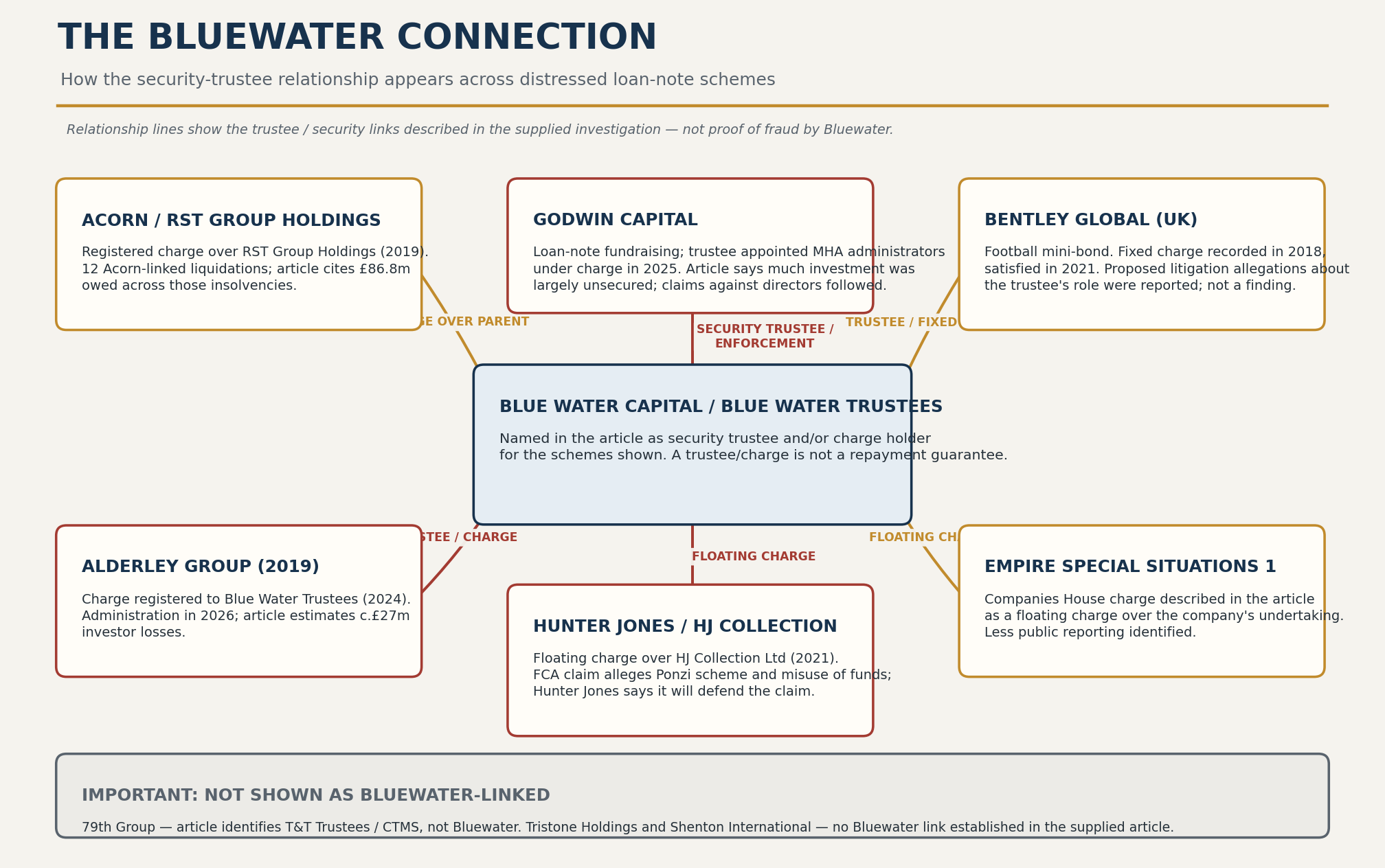
Empire Special Situations 1 Limited is another entry in the Bluewater charge register. Companies House records show a floating charge in favour of Blue Water Capital Limited, covering all the property or undertaking of the company, with the chargor acting as a bare trustee for the property.
A floating charge is a weaker form of security than a fixed charge. It allows the company to continue dealing with its assets in the ordinary course of business until the charge “crystallises” — typically on insolvency or enforcement. In practice, by the time a floating charge crystallises, the assets may have been sold, encumbered or dissipated.
Empire Special Situations 1 Limited has not attracted the same level of public reporting as Godwin or Acorn. But its presence in the Bluewater portfolio reinforces the pattern: a trustee holding security that sounds comprehensive in the documents but may be far less protective in reality.
Part Seven: The 79th Group — the trustee that was not Bluewater
It is important to be precise about what the evidence shows — and what it does not.
The 79th Group is facing its own serious crisis. It suspended redemption and interest payments on its loan notes, and in February 2025 four people connected to the business were arrested as part of a fraud investigation. The company has been described by insolvency specialists as exhibiting the hallmarks of a classic Ponzi scheme.
But the security trustee for the 79th Group was not Bluewater Capital. It was T&T Trustees, with Castle Trust & Management Services Ltd (CTMS) listed as trustee on certain charges. CTMS is now in liquidation. Insolvency & Law has highlighted “troubling security trustee issues”, including a Debenture Deed that failed to clearly identify the properties over which the charge applied and relied on a floating charge.
The 79th Group therefore belongs to the broader pattern of failed unregulated loan-note schemes with weak trustee arrangements — but it is not part of the Bluewater cluster. Any investigation that lumps it together with Bluewater without evidence would be inaccurate.
The same caution applies to Tristone Holdings and Shenton International. Tristone Holdings Limited (company number 11366010) is in liquidation, but no Bluewater charge or directorship link has been found. Shenton International Bonds Plc was dissolved in 2021, but no public document connects Bluewater to the Shenton bond issue. They are part of the wider landscape of failed property investment vehicles, but the Bluewater thread is not established for them.
Part Eight: What a security trustee actually does — and does not do
The repeated appearance of Bluewater Capital across these cases raises a question that goes to the heart of the unregulated loan-note market: what is a security trustee for?
In a typical secured loan note, the trustee holds the security on trust for the noteholders collectively. The trustee’s duties are set out in a security trust deed. It may have powers to enforce the security, appoint administrators, and distribute recoveries. It is not a guarantor. It does not promise that the assets will be worth enough to repay the notes. It does not usually verify the borrower’s business plan or the accuracy of the marketing.
Bluewater’s own website is clear that it acts “solely for the security holders, with no other side to serve”. But its role is also described as operational and administrative: “client engagement, ongoing trust administration”. The trustee manages the paperwork of security. It does not underwrite the investment.
That distinction is legally important. It is also easily lost on retail investors who see the words “security trustee” and “first legal charge” and conclude that their capital is safe. The FCA does not regulate the loan notes themselves. The FCA authorises Bluewater for certain activities, but that authorisation does not extend to approving or guaranteeing unregulated loan-note products. The FSCS does not cover security trustee services.
The result is a regulatory blind spot in which the presence of an FCA-authorised trustee lends credibility to an investment that is otherwise outside the regulatory perimeter. The trustee earns fees for holding the security. The borrower raises the money. The investor carries the risk.
Part Nine: The pattern
Across the Bluewater cluster, a consistent pattern emerges:
1. The security is real but limited. Bluewater holds charges. They are registered at Companies House. They are not invented. But the value behind the charge may be far less than investors were led to believe. In Godwin, much of the investment was largely unsecured. In Acorn, the parent company over which the charge sits is balance-sheet insolvent. In HJ Collection, the FCA alleges the assets were never bought.
2. The trustee enforces when the borrower fails. In Godwin and Alderley, Bluewater used its charge to appoint administrators. That is the trustee doing its job. But enforcement is not recovery. Administration preserves value; it does not create it.
3. The marketing relies on the trustee’s name. In case after case, investors were told they had “extra security” because Bluewater held a first legal charge. The trustee’s FCA authorisation was used as a credibility signal. The FSCS exclusion and the limits of the trustee’s role were buried in the small print.
4. The losses are borne by retail investors. Godwin: an estimated £155 million lost. Acorn: £86.8 million owed to creditors across liquidated SPVs. Alderley: £27 million in investor losses. HJ Collection: the FCA alleges a Ponzi scheme. Bentley: litigation against the trustee itself.
5. The trustee continues to trade. Bluewater Capital remains an FCA-authorised firm. It continues to offer security trustee services. Its website continues to describe its role as holding security on behalf of lenders and acting on enforcement. There is no public indication that the FCA has taken enforcement action against Bluewater itself.
The unanswered questions
The investigation raises questions that go beyond any single company.
For Bluewater Capital: Did the firm conduct adequate due diligence on the borrowers for whom it acted as security trustee? Did it verify that the security it was holding was worth what investors were told? Did it disclose the limitations of its role clearly enough? And when it certified investment memoranda — as alleged in the Bentley case — what standard did it apply?
For the FCA: The regulator authorised Bluewater as a firm. It warned about Acorn’s investment arm repeatedly. It brought a case against Hunter Jones. But it did not prevent the same trustee from appearing across multiple failed schemes. Is the regulatory perimeter wide enough to catch the enablers, or does it stop at the borrower?
For investors: The lesson is uncomfortable. A security trustee’s name on a document is not a guarantee. A first legal charge is only as good as the assets behind it. An FCA authorisation of the trustee does not mean the investment is FCA-regulated. And an unregulated loan note is, at bottom, a bet on a property developer — with a trustee holding the paperwork when the bet fails.
Epilogue: the name on the door
Bluewater Capital’s Birmingham office is at Quadrant Court, 49 Calthorpe Road, Edgbaston. It is a respectable address. The firm’s LinkedIn page describes it as a boutique UK firm “authorised and regulated by the FCA” with “a strong bias for versatility”. Its trustee arm is supervised under HMRC’s money laundering regulations.
None of that is inherently improper. Security trustees perform a necessary function in debt markets. The problem is not that Bluewater exists. The problem is that the security trustee model, as it operates in the unregulated loan-note market, has repeatedly produced the same outcome: investors believing they are secured, and then discovering that the security does not mean what they thought it meant.
Acorn’s founder was convicted of mortgage fraud earlier on and served time, got released and committed a new kind of fraud which he hopes to get away with. Godwin’s directors face a £155 million freezing order. Hunter Jones faces a Ponzi allegation. Alderley left £27 million in losses. Bentley led to litigation against the trustee. And in each case, the documents said there was a security trustee.
The name on the paperwork was Bluewater. The money was gone.